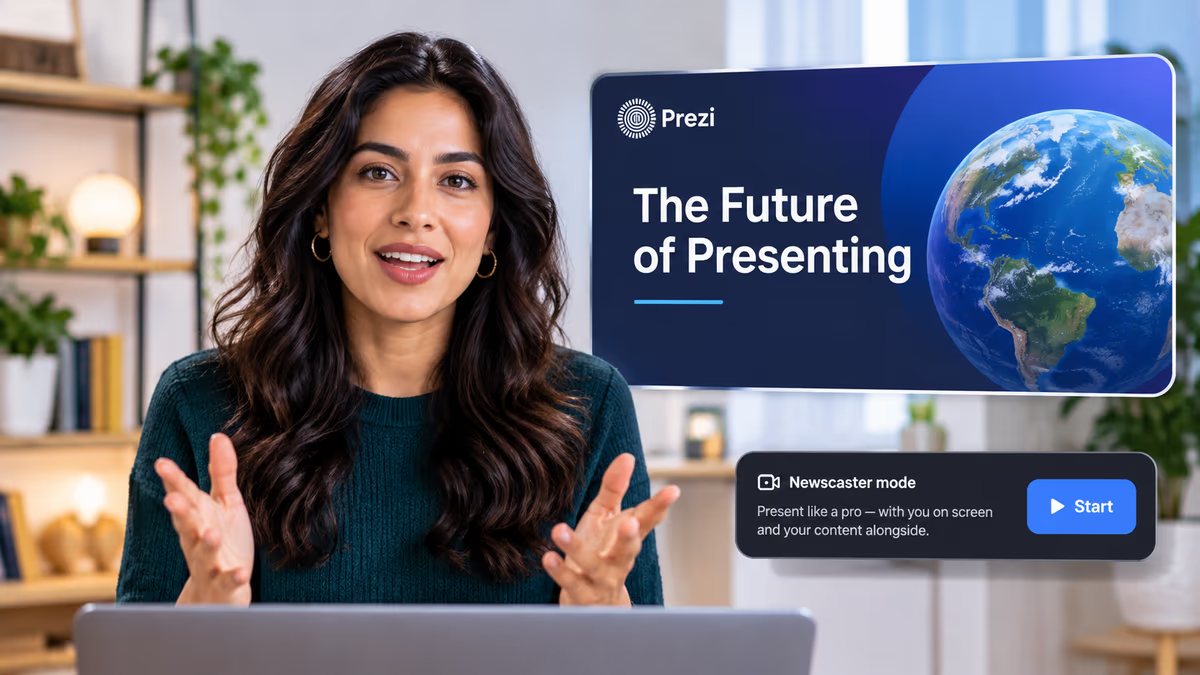
Medical presentations carry more weight than most. A case conference shapes a treatment decision. A research talk shapes funding. A board report shapes a hospital's budget. A nursing in-service decides whether a new protocol is followed on the night shift.
Most AI presentation tools stop at the draft. They hand you slides, and the rest is on you. You still have to find out whether the residents followed the differential, answer the question that jumps three slides ahead, and give the people who missed grand rounds something better than a recording.
Quick answer for staff training: Prezi is a strong choice for clinical educators who need a training presentation fast. Import the in-service or compliance slides you already run, or describe the session in a sentence, and Prezi builds it. Add a quiz at the step where staff get confused, run it live with a QR code, then share the link so staff on other shifts can review it as flashcards or a self-test. SCORM export sends completion data to your LMS, and the activity report shows answer rates and percent correct.
This guide compares the leading AI presentation tools for healthcare work, explains what to look for, and walks through the presentations clinicians, clinical educators and administrators ask about most.
What makes a medical presentation different
Healthcare audiences read slides differently. Before comparing tools, name the requirements.
-
Dense, structured evidence. Methods, outcomes, confidence intervals and cohort tables need room and a clear hierarchy. Formulas need to render correctly.
-
Narrative order. A case presentation follows a set arc: presentation, history, findings, differential, management, outcome, discussion.
-
Source material already exists. Most clinicians start from a paper, a PDF, a protocol or last year's slides, not a blank page.
-
Questions arrive out of order. A resident asks about imaging while you are still on the history. The presentation has to bend to the room.
-
Understanding is the job. An attending is accountable for what residents walk away knowing, and a nurse educator for what staff do differently on the unit.
-
Mixed audiences. The same findings go to peers, trainees, executives and sometimes patients, each needing a different depth.
-
Consistency and control. Hospitals and pharma teams need brand rules followed and content kept under team control.
How the leading AI presentation tools compare
| Tool | What it does for medical work | Where it falls short |
|---|---|---|
| Prezi | Turns the PowerPoint, PDF or Word material you already have, or a sentence describing the session, into an interactive presentation. Live polls, quizzes, Q&A and word clouds that everyone joins by QR code, with no app and no login, plus interactive slides you adjust live. Afterward, the same shareable link works as flashcards, a self-test, an audio summary or a narrated video. An activity report, brand kits, SCORM export, and PowerPoint export with speaker notes. | The canvas takes a session or two to get used to. Imported slides keep their original order, so you can present straight through and move around the canvas as you get comfortable. |
| PowerPoint with Copilot and Google Slides | Familiar, widely used, and often the format a hospital or conference already expects. Copilot drafts slides from a prompt or a document. | Design and structure depend heavily on the author, and live polls or quizzes usually come from a separate tool. Prezi imports both, so your existing slides come with you. |
| Canva | Large library of designs, easy visual editing, and built-in polls, quizzes and live Q&A. | Built for design-led slides rather than long, evidence-heavy narratives. Prezi imports Canva designs, so you can start from what you already made there. |
| Gamma | Fast first draft from a prompt or pasted content. Imports PowerPoint and Google Slides, exports to PowerPoint and PDF, and paid plans show view analytics on shared links. | No built-in live polls or quizzes, so audience interaction relies on embeds or third-party add-ons. Card layouts do not always translate cleanly to 16:9 PowerPoint slides. |
| Beautiful.ai | Smart Slides handle layout, spacing and alignment automatically. PowerPoint export, brand controls, and viewer analytics on paid plans. | Rigid layouts limit custom designs and dense data visualizations. No free plan, only a 14-day trial. |
| Live polling tools (Mentimeter, Slido, Kahoot) | Strong at polls, quizzes and Q&A, and several offer self-paced modes. Most connect to PowerPoint or import slides. | Built around the poll or quiz rather than the presentation, so most teams still build and manage their slides in a second tool. |
Prezi is the only product G2 ranks in the top three of Presentation Software, AI Presentation Tools, and Audience Response at the same time (as of August 2026). Canva does not appear in G2's Audience Response category, and Slido does not appear in Presentation Software or AI Presentation Tools. For a clinical educator, one tool does what four used to.
Verify current feature and security details on each vendor's site before you decide. Check any tool that touches patient information against your organization's privacy and compliance policies, and remove patient identifiers from slides regardless of the tool.
What the newest Prezi update adds for clinical presenters
Prezi's newest update puts your slides, live activities, and practice tools in one simpler workspace, on a rebuilt editor. Here is what matters most for healthcare.
-
Equations that read like equations. The new editor renders math cleanly, so a pharmacokinetics formula, a dosing calculation or a sample size equation looks right on the slide.
-
Imports that look like the original. PowerPoint files come in much closer to how you made them, with fonts, line spacing, shadows and highlights intact. Nothing to rebuild.
-
Exports a conference will accept. PowerPoint export now includes your speaker notes and embedded fonts and always produces a real .pptx file. PDF exports of 60 or more slides run in the background while you keep working.
-
Activities placed where the thinking happens. Add a poll, quiz, word cloud or Q&A to your timeline right next to the slide it belongs with. When you reach it, it is ready.
-
Answers revealed on your terms. Quiz scores and poll results stay hidden until you choose to show them, so residents commit to their own answer before they see the room's.
-
Explain it by moving it. Interactive slides put a hands-on model on your slide that you adjust live as you teach, so the audience watches a relationship change instead of reading about it. They sit in your timeline like any other slide, next to your quizzes and polls. Prezi suggests interactive slides that fit your topic from a library of more than 140, in English, Spanish, Portuguese and French.
-
See what landed across every session. The activity report shows responses across your presentations, the answer rate, the percentage answered correctly, the questions your audience asked, and suggestions for what to change next time.
-
Your phone as the presenter remote. Scan a QR code and your phone or iPad shows your speaker notes and activity controls while the screen shows only the slides. No app to download. Useful for anyone who teaches from the side of a lecture hall or walks a skills lab.
-
Review after the session. Flashcards, practice quizzes, an audio summary and a narrated video, all generated from your presentation, so a resident coming off nights can catch up on their own schedule.
-
Clear sharing controls. Privacy icons on project thumbnails show at a glance which presentations are public and which are private, and the share panel now includes a QR code.
-
A start from ChatGPT. The Prezi app in ChatGPT now works for free ChatGPT users and can bring in your PowerPoint files.
Use case 1: Staff training and clinical education, built quickly
Annual competencies, new protocols and onboarding all run on slides someone already built. The trouble is that those slides are designed to be watched, and a completion rate does not tell you whether anyone can follow the new sepsis bundle.
A training deck in four steps:
-
Start from what you have. Import last year's in-service, the protocol PDF or a Word document. Or type: "A 20-minute in-service for night shift nurses on the new sepsis bundle. Include a quiz on the first-hour steps."
-
Refine by chat. Ask for a tighter step sequence, a summary slide or an added learning objective. Say "undo that" if a change misses.
-
Place the checks. Add a poll, quiz, word cloud or Q&A next to the slide it belongs with. Results stay hidden until you reveal them.
-
Run it and report. Staff join from any device by QR code with no app and no login. Afterward, the activity report shows answer rates and percent correct, and SCORM export sends completion data to your LMS.
More ways to use it:
-
Bring the training you already run. Import existing in-service and compliance slides as they are. Your brand kit keeps them on brand.
-
Check understanding during the session. Quizzes and polls show which step of a protocol the group is unsure about while you can still fix it.
-
Use polls to start from the right place. Open with a poll on how confident staff feel with the protocol, then spend your time on the steps they chose.
-
Use a word cloud for barriers. Ask staff what gets in the way of following the new protocol on a busy shift, and read the answers together.
-
Hold questions for Q&A. Staff who would not interrupt a supervisor can send a question and upvote the ones that matter.
-
Remote counts as present. Staff on another unit or shift join the same session from any device by scanning a QR code.
-
Teach from the side of the room. Your phone shows speaker notes and activity controls while the screen shows only the slides, which suits skills labs and unit huddles.
-
Leave something to review. The same shareable link becomes flashcards, a self-test or a narrated video for anyone who needs another pass.
-
Report to your LMS and to leadership. SCORM export sends completion data to your learning management system. The activity report shows answer rates and percent correct across sessions, so leadership gets proof rather than completion percentages.
Use case 2: How to build a medical case study presentation with AI
A strong case presentation is a story with a clinical spine. AI helps most when you give it structure and de-identified facts.
-
De-identify first. Remove names, dates of birth, record numbers and any detail that could identify the patient.
-
Pick your way in. Upload the de-identified summary, discharge notes or last year's slides. Or describe the session in a sentence: "A 20-minute case conference for PGY-1 residents on an adolescent with new-onset DKA. Include a quiz on fluid management." Prezi builds from either.
-
Set the arc. Ask for the standard sequence: presenting complaint, history, exam and investigations, differential diagnosis, management, outcome and teaching points.
-
Refine by chat. Ask Prezi to tighten the differential slide, turn the lab table into a trend visual or add a learning-objectives slide. If a change misses, say "undo that" and the earlier version comes back.
-
Ask before you reveal. Place a poll right before the diagnosis: "What is your leading diagnosis?" Residents answer from their phones, and the results stay hidden until you show them. Q&A collects questions from the people who would never raise a hand in front of an attending.
-
Teach in the order the room needs. On the canvas, imaging, labs and the differential each sit in their own area. When the poll shows half the room missed the anion gap, go straight there instead of arrowing back through ten slides.
-
Export or share. Export to PowerPoint, speaker notes included, when a conference or institution requires it. Share the link with everyone else.
-
Sharpen it for next time. The activity report shows which questions residents got wrong, what they asked, and what to change before you run the case again.
Use case 3: Turning medical research or public health data into a clear visual presentation
Research presentations fail when every finding gets equal weight. Choose the one result per slide that the audience must remember.
-
Lead with the question and the answer. State the clinical question, then the headline result, then the evidence.
-
One message per slide. Use the slide title as the conclusion ("Readmissions fell 18% after discharge calls"), not a label ("Results").
-
Match the chart to the claim. Trends get lines, comparisons get bars and distributions get plots. Keep confidence intervals visible.
-
Show the mechanism, not just the result. An interactive slide lets you adjust a variable in front of the room, such as a dose or an exposure level, so the audience sees the curve respond before you show your data.
-
Start from the paper. Import the PDF or manuscript and let Prezi propose an outline, then edit the structure yourself. Equations from your methods section render cleanly.
-
Simplify public health data for lay audiences. Replace jargon, round thoughtfully and show the denominator.
-
Check the headline landed. A one-question quiz after the results slide tells you whether the audience took away the effect size or just the p-value.
-
Add the limitations slide. Audiences trust presenters who state the limits of their data.
Use case 4: Board-level hospital reporting
Board members want decisions, not data dumps. Healthcare administrators can use AI to get from a quarterly spreadsheet to a briefing presentation quickly.
-
Open with the ask. What decision or awareness does this report need?
-
Use a fixed scorecard. Quality, safety, volume, financial performance and staffing, in the same order every quarter.
-
Show trend and target together. A number without a benchmark does not help a board.
-
Put detail in an appendix. Keep the main presentation to the points that drive discussion, and jump to the appendix on the canvas when a board member asks.
-
Collect questions ahead of time. Share the link before the meeting and open Q&A, so the discussion starts from what the board wants to know.
-
Keep branding consistent. Your brand kit applies approved logos, colors and fonts across every report.
-
Keep it private. Privacy icons show at a glance which reports are private before anything gets shared.
Other healthcare presentations worth building
-
Clinical research presentations for conferences and grand rounds, following the question, methods, results and implications structure.
-
Patient case presentations for medical school, where the teaching points matter as much as the case.
-
Nursing and allied health education, where a quick knowledge check before and after shows what changed.
-
HCP education presentations for pharma and device teams, where speed and message discipline matter.
Checklist: choosing an AI presentation tool for healthcare
-
Can it start from your existing Word, PDF or PowerPoint content, or from a sentence describing the session?
-
Can you refine slides through conversation, not only regenerate them?
-
Does it handle dense tables, charts, equations and structured evidence cleanly?
-
Can the audience take part in polls, quizzes and Q&A without installing an app?
-
Does the material keep working after the session for people who need to review it?
-
Can you see which questions landed, across sessions, and what to change next time?
-
Can you enforce brand rules across a team?
-
Does it export to PowerPoint, and to your LMS through SCORM, for institutions that require it?
-
Does it fit your organization's privacy and compliance requirements?
-
Can you show that staff understood the training, not only that they attended, through answer rates and percent correct?
The takeaway
Your slides hold years of clinical judgment about what matters and in what order. The best AI presentation tool for medical work builds from that judgment, keeps the evidence and the narrative intact, and lets you answer questions as they come. Prezi turns the material you already have into a session where residents, staff and colleagues take part and show what they understand, then keeps it working afterward. For a training team, that means a deck built in minutes from material you already run, with quizzes that show who understood the new protocol.
Bring your slides, or describe the session you need, and start a healthcare presentation in Prezi.
FAQ
What AI deck builder do clinical educators recommend for staff training presentations? Prezi is a strong choice because it turns your existing in-service, compliance or protocol material into an interactive presentation in minutes. You add quizzes, polls, word clouds and Q&A that staff answer from their phones, and the same link works afterward as flashcards, a self-test or a narrated video. SCORM export and the activity report show completion, answer rates and percent correct.
How quickly can I build a staff training presentation with AI? Import your existing slides or describe the session in one sentence, and Prezi drafts the presentation. Most of your time then goes into checking the clinical content and placing quizzes where staff need to think.
Can staff on other shifts complete the training? Yes. Anyone can join a live session from any device by scanning a QR code, and the shareable link works afterward for staff who need another pass.
What is the best AI presentation tool for medical presentations? Prezi is a strong choice because it turns existing PowerPoint, PDF and Word material into an interactive presentation with live polls, quizzes and Q&A. It is the only product G2 ranks in the top three of Presentation Software, AI Presentation Tools and Audience Response at the same time (as of August 2026). Presentations export to PowerPoint, with speaker notes, when a conference requires it.
Can I turn a medical research paper into a presentation with AI? Yes. Import the PDF or manuscript into Prezi and it proposes an outline and slides that you then edit yourself. Equations, tables and charts render cleanly, and you can refine any slide through chat.
How do I make a grand rounds or case conference presentation interactive? Add a live poll, quiz or Q&A to your Prezi presentation next to the slide it belongs with. The audience joins by scanning a QR code on any phone, with no app and no login. Results stay hidden until you reveal them, and the activity report shows which questions landed and what to change next time.
Is it safe to use AI presentation tools with patient information? Remove patient identifiers from any presentation before you use an AI tool, whichever tool you choose. Check each tool against your organization's privacy and compliance policies before uploading clinical material.
Can residents or staff review a presentation after the session? Yes. A Prezi shareable link keeps working after the session as the full interactive presentation, a narrated video, an audio summary, flashcards or a self-test. Training teams can also use SCORM export to send completion data to their LMS.