You're about to create your best presentation ever

Success Story Presentation Template

Create your presentation by reusing one of our great community templates.

Success Story

Transcript: First Round of P90x After three years of working out and dieting. Before Three years ago I changed my life with P90X. I was headed down the road to high blood pressure, diabetes, and heart attack. My eating habits were the normal “American Diet” and my physical activity consisted of getting up off the couch to go to the refrigerator. Success Story It was tough in the beginning as I was having trouble doing most of the exercises and was so sore that I could hardly get out of bed in the morning, but I was determined to get my health back and to get strong. I just kept “pushing play” and taking Tony’s advice to just “do your best and forget the rest”. I was working out in the privacy of my own home so there was no one to judge me if I was having to do pushups on my knees, or having to stop the tape to catch my breath in order to continue. What happened over the next three months was nothing short of amazing. I started to improve in all areas, by tracking my progress I would always try to just “do one more rep than the last time” and I went from doing pushups on my knees to doing clapping pushups. To having to use the chair to do just one pull-up to being able to do corncob pull-ups (you will learn about those little beauties once you start the program). I started to feel great and the weight was melting off of me. The whole family started getting healthy, even the neighbors joined in! He has changed many peoples lives by coaching them online and giving them tips! He has gotten ride of all his medicine he used to take for high blood pressure, hasn't been sick in years,recovered from a surgery, and has transformed his life in ways you could never dream! How its affected other peoples lives

Success Story

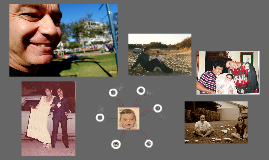
Transcript: Success Traits: My father values working, studying Parents Good life advice Julio Dellasanta Profound Statement: Being offered a job in the U.S Being married for so long (he said chuckling) Being a recognized and respected professional in his field. Family Patient Persistent Studious Honest Sociable and "playing." For as long as I've known him, he has spent day after day doing just that. He works Monday through Saturday (and often Sundays) from 6 to 7, comes home and begins studying about the new airplane he is in charge of fixing, or studying for his next leadership exam. And whenever he has a free moment, all to himself, he sends mom and I out of the house and begins playing his trumpet like he's 12 years old again. Major Influences: Major Life Events: Moving to the United States Marrying my mother The births of his three kids The births of his four grandchildren His Values: My Values: His knee surgery The language barrier I personally value food, happiness, art, consistency, and companionship. Though my values differ from my dad's he embodies what I believe in. {Connection} Bio: Major Obstacles: Julio Dellasanta, was born on December 13, 1956 in Buenos Aires, Argentina, to Luisa Rao and Luis Dellasanta. He spent his early childhood going to school, and playing outdoors. One of his favorite pastimes (and the source of some great anecdotes) was throwing rocks at people from the roof of his house. My father has two siblings, Adriana, who is older than him, and Luis (we call him Tati) who is younger. His "high school" years were spent going to technical school from 8AM to 6PM and learning about mechanics. When he was 20 he marries the Andrea Rico, with whom he recently celebrated his 36th anniversary. He built his own home and ran a body shop for several years, until he began working as an avionics mechanic (which just means he fixes airplanes. In 2003 he relocated to the United States, where he has lived ever since. He works for a small company in Ft. Lauderdale as team leader for a group of wonderful co-workers and friends. "Work hard, play hard." Mom- "Gilera!" Me- "I'm sorry, what?" Mom- "Moto...like Harley Davidson!" Dad- "To find happiness in the simple things in life. By: Juliana Dellasanta Life If you couldn't tell from our names, Julio is my father, and my biggest role model. To me, he is the epitome of success. He comes home every night after sometimes working 18+ hours kisses my mother and gives me a hug as if his day was spent lounging around. You would never know from the smile on his face and the pep in his step that he spent hours moving engines, crawling into airplane ducts and running back and forth from hangar to hangar in 90 degree weather. He does have bad days. Days where he just wants to go straight from work to bed. Days where he doesn't want to talk. But that makes him all the more human and all the more admirable. My father is humble, and knowledgeable and the happiest man I know. If in the future I'm anything like him, I know I'll be successful. Awards/Accomplishments:

Research Story Presentation Template

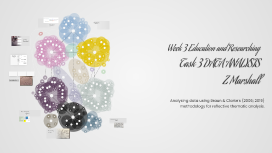
Transcript: Conclusion and Key Personal Learning Points Braun & Clarke's (2006, 2019) six phase methodology helps keep this rather fluid, messy and organic process on track. The thematic map here came out of my more fluid drawings and I attempted to put it into a digital mindmap. Mostly to practice using digial tools (mindmeister.com - which is a tool I sometimes recommend to my students although I rarely use it myself), but I was also curious to see what effect the constraints of using digital media would have on my visualisation. In the same way I am curious to see what the effect of using NVivo software will have on this entire process. I am not entirely happy with the outcome as it is not as flexible as I would like it to be. I would like to focus more on the overall 'shape' of these themes, which may go some way to forming the narrative for phase 5. The rigid nature of this map does not inspire me to see how relations are formed between the themes. Coding is very time consuming! I wonder how Nvivo might help with this? Phase 4: Reveiwing Potential Themes I found a narrative started to literally take shape - but this shape was helped by a more creative almost 'drawn' approach. I feel quite hemmed in by certain elements of technology. This suddenly reminds me of the project described in Blair Matthews' lecture of the participatory comic research, Davis et al. (2021). Perhaps I can relate to this type of creative research methodology. Evolution of Themes The iterative analysis process allowed for the refinement and evolution of themes as new insights emerged from the data. Each round of analysis contributed to a deeper understanding of the subject matter. Enrichment through Collaboration Reflections on Theme Development Collaboration with peers brought diverse perspectives, enriching the thematic development and allowing for a more comprehensive understanding of the research findings. This teamwork was vital in identifying nuances within the data. Importance of Continuous Reflection Continuous reflection throughout the research process was essential for gaining depth in analysis. It enabled researchers to critically assess their interpretations and adjust their focus as new themes emerged. Table of themes for spectrum 1 with evidence from data I created a table, for the themes from spectrum 1 with evidence from the data. Here you can visually see the quantity of codes reflecting the higher volume of the code 'HE is beneficial for individual self-development' on the left, compared to the code 'HE is benefical for humanity globally' on the right. I can see that NVivo has the ability to quantify more efficiently which has both advantages and disadvantages depending on your overall approach. Week 3 Education and Researching Task 3 DATA ANALYSIS Z Marshall Two strands or spectrums Spectrum 1 Spectrum 2 or circle... The first spectrum I visualised going from HE benefitting the individual to HE benefitting humanity, with the family and society in between. I noticed there seemed to be quantitatively more codes on the individual side. This made me wonder about the disciplines these participants came from and whether there might be any connections. The second spectrum could almost be a full circle, with vocational knowlege being very close to the discipine-specific knowldge, rather than in my image with one on the opposite extreme. This also made me reflect on the nature of knowledge versus skills in HE, the theory versus practice debate, which is so prevalent in eduction. I recently visited NCSU campus in the USA and their moto is 'Think and Do', which quite literally fits both these purposes. I identified or developed, two strands in my codes. One related to a spectrum of who HE should (or does) benefit. I reflected on the fact that some of the data seemed to be more ideological and focused on the word 'should' in the question, but some seemed to be more descriptive and seemed to answer 'What do you think the purpose of HE is?' The other strand was focused on a variety of knowledge and skills. Phase 3: Developing Themes Analysing data using Braun & Clarke's (2006; 2019) methodology for reflective thematic analysis. Phase 2: Generating codes using Excel I used excel to document my coding. I actually wanted to try out using NVivo having watched the tutorials, but I had problems downloading it so carried on with Excel. The image shows an extract of my columns: the first after the data has a descriptive/semantic code, the second column has a more interpretive code. As discussed in the lecture and this week's readings, I found myself going back and forth as ideas were springing up in non-linear ways. It was a relief to hear that this seemingly non-systematic approach is common in coding. I felt the 'flexible and organic' development of codes (Byrne, 2022) and it came quite naturally during the thought process. I created another column for my reflections to keep track of my reactions and to notice where I felt I may have personal

Now you can make any subject more engaging and memorable