You're about to create your best presentation ever

Story Presentation Template

Create your presentation by reusing one of our great community templates.

Research Story Presentation Template

Transcript: Conclusion and Key Personal Learning Points Braun & Clarke's (2006, 2019) six phase methodology helps keep this rather fluid, messy and organic process on track. The thematic map here came out of my more fluid drawings and I attempted to put it into a digital mindmap. Mostly to practice using digial tools (mindmeister.com - which is a tool I sometimes recommend to my students although I rarely use it myself), but I was also curious to see what effect the constraints of using digital media would have on my visualisation. In the same way I am curious to see what the effect of using NVivo software will have on this entire process. I am not entirely happy with the outcome as it is not as flexible as I would like it to be. I would like to focus more on the overall 'shape' of these themes, which may go some way to forming the narrative for phase 5. The rigid nature of this map does not inspire me to see how relations are formed between the themes. Coding is very time consuming! I wonder how Nvivo might help with this? Phase 4: Reveiwing Potential Themes I found a narrative started to literally take shape - but this shape was helped by a more creative almost 'drawn' approach. I feel quite hemmed in by certain elements of technology. This suddenly reminds me of the project described in Blair Matthews' lecture of the participatory comic research, Davis et al. (2021). Perhaps I can relate to this type of creative research methodology. Evolution of Themes The iterative analysis process allowed for the refinement and evolution of themes as new insights emerged from the data. Each round of analysis contributed to a deeper understanding of the subject matter. Enrichment through Collaboration Reflections on Theme Development Collaboration with peers brought diverse perspectives, enriching the thematic development and allowing for a more comprehensive understanding of the research findings. This teamwork was vital in identifying nuances within the data. Importance of Continuous Reflection Continuous reflection throughout the research process was essential for gaining depth in analysis. It enabled researchers to critically assess their interpretations and adjust their focus as new themes emerged. Table of themes for spectrum 1 with evidence from data I created a table, for the themes from spectrum 1 with evidence from the data. Here you can visually see the quantity of codes reflecting the higher volume of the code 'HE is beneficial for individual self-development' on the left, compared to the code 'HE is benefical for humanity globally' on the right. I can see that NVivo has the ability to quantify more efficiently which has both advantages and disadvantages depending on your overall approach. Week 3 Education and Researching Task 3 DATA ANALYSIS Z Marshall Two strands or spectrums Spectrum 1 Spectrum 2 or circle... The first spectrum I visualised going from HE benefitting the individual to HE benefitting humanity, with the family and society in between. I noticed there seemed to be quantitatively more codes on the individual side. This made me wonder about the disciplines these participants came from and whether there might be any connections. The second spectrum could almost be a full circle, with vocational knowlege being very close to the discipine-specific knowldge, rather than in my image with one on the opposite extreme. This also made me reflect on the nature of knowledge versus skills in HE, the theory versus practice debate, which is so prevalent in eduction. I recently visited NCSU campus in the USA and their moto is 'Think and Do', which quite literally fits both these purposes. I identified or developed, two strands in my codes. One related to a spectrum of who HE should (or does) benefit. I reflected on the fact that some of the data seemed to be more ideological and focused on the word 'should' in the question, but some seemed to be more descriptive and seemed to answer 'What do you think the purpose of HE is?' The other strand was focused on a variety of knowledge and skills. Phase 3: Developing Themes Analysing data using Braun & Clarke's (2006; 2019) methodology for reflective thematic analysis. Phase 2: Generating codes using Excel I used excel to document my coding. I actually wanted to try out using NVivo having watched the tutorials, but I had problems downloading it so carried on with Excel. The image shows an extract of my columns: the first after the data has a descriptive/semantic code, the second column has a more interpretive code. As discussed in the lecture and this week's readings, I found myself going back and forth as ideas were springing up in non-linear ways. It was a relief to hear that this seemingly non-systematic approach is common in coding. I felt the 'flexible and organic' development of codes (Byrne, 2022) and it came quite naturally during the thought process. I created another column for my reflections to keep track of my reactions and to notice where I felt I may have personal

Presentation template

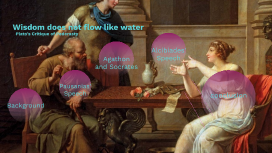
Transcript: Wisdom does not flow like water Plato’s Critique of Pederasty Pederasty Background Symposium Pederasty My Project Pausanias' Speech Pausanias' Speech Two Aphrodites Uranian Heavenly Pandemos Common Text Text Pictures Pictures "Here, Socrates, lie down alongside me, so that by my touching you, I too may enjoy the piece of wisdom that just occurred to you while you were in the porch. It is plain that you found it and have it, for otherwise you would not have come away beforehand." Agathon and Socrates “It would be a good thing, Agathon, if wisdom were the sort of thing that flows from the fuller of us into the emptier, just by our touching one another, as the water in wine cups flows through a wool thread from the fuller to the emptier. For if wisdom too is like that, then I set a high price on my being placed alongside you, for I believe I shall be filled from you with much fair wisdom. My own may turn out to be a sorry sort of wisdom, or disputable like a dream; but your own is brilliant and capable of much development, since it has flashed out so intensely from you while you are young; and yesterday it became conspicuous among more than thirty thousand Greek witnesses." "You are outrageous, Socrates," Agathon said. "A little later you and I will go to court about our wisdom, with Dionysus as judge, but now first attend to dinner." how water flows Principle at play When they do engage in a contest about love Timeline YEAR Alcibiades' Speech Socrates, he claims, is like “those silenuses that sit in the shops of herm sculptors, the ones that craftsman make holding reed pipes or flutes; and if they are split in two and opened up they show they have images of gods within.” (215b) Alcibiades' Speech You, in my opinion,' I said, 'have proved to be the only deserving lover of mine; and it seems to me that you hesitate to mention it to me. Now I am in this state: I believe it is very foolish not to gratify you in this or anything else of mine—my wealth or my friends—that you need; for nothing is more important to d me than that I become the best possible; and I believe that, as far as I am concerned, there is no one more competent than you to be a fellow helper to me in this. So I should be far more ashamed before men of good sense for not gratifying a man like you than I should be before the many and senseless for gratifying you.' Seduction Scene 'Really, my dear Alcibiades, you're no sucker if what you say about me is really true and there is some power in me e through which you could become better. You must see, you know, an impossible beauty in me, a beauty very different from the fairness of form in yourself. So if, in observing my beauty, you are trying to get a share in it and to exchange beauty for beauty, you are intending to get far the better deal. For you are trying to acquire the truth of beautiful things in exchange for the seeming and opinion of beautiful things; and you really have in mind to exchange "gold for bronze." But blessed one do consider better: Without your being aware of it—I may be nothing. Thought, you know, begins to have keen eyesight when the sight of the eyes starts to decline from its peak; and you are still far from that.' Conclusion conclusion If Socrates were to have sex with Alcibiades, he would perpetuate: 1) the idea that people can make each other wise. impact: prevent Alcibiades from realizing his ignorance about wisdom 2) Alcibiades belief that his physical attractiveness is the most important thing about him impact: the belief could harm Alcibiades as he begins to decline from his physical peak, when “Thought begins to have keen eyesight.” (219a) 3) Socrates would be no better than the sophists who cannot acknowledge the ways in which they are ignorant, and thus, risk self-deception. Advantages Advantages to my account: -Fits with the well-known picture of a Socrates who: 1) proclaims his own ignorance. 2) critiques the Sophists for i. both not acknowledging what they do not know ii. exchanging money for wisdom -Makes explicit the way Plato critiques the customs of his time -Throws into question a vision of Socrates as someone who consistently denies bodily urges -Makes clear that the container model is supposed to function in opposition to the image of pregnancy and birth. Accounts of “Plato’s Appropriation of Reproduction” run these two images together.

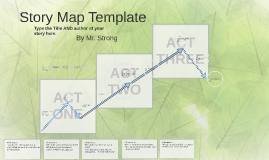
Story Map Template

Transcript: Character 1: Describe the protagonist of your story. What makes him or her unique or interesting? Character 2: Who is the antagonist of your story? What does he or she have in common with the protagonist? Character 3: Who is the love interest in your story? How does he or she make the protagonist's life more interesting? Major Conflicts What are the "big ideas" in your story? What philosophical or moral questions are being addressed? What are the reasons the author chose to write this book? What happened after the battle was over? In this space, type about what the world was like before the story got started Who lives here? What are the rules? Is there magic? What kind of language do people use? What is the setting like? What kind of stuff was going on? What happened in the final battle? How was the Central Conflict of the story resolved? Describe the first few things that happen in the story after the inciting incident Abyss Climax Conventions of the Genre Describe the moment you knew the world was changed forever and life would never go back to the way it was before. What happens to change the world as we know it? How does the life of the protagonist change? Falling Action By Mr. Strong Denouement When did it all go wrong? Why did it look like everything was lost? ACT ONE Character 4: Who is the shaman of your story? What unique wisdom or insight does this person have? What was life like for the characters after the story was over? Describe the next few things that happen in the story Type the Title AND author of your story here Midpoint Major Themes Story Map Template Exposition Rising Action ACT TWO Think about the biggest conflicts in your story - there may be more than one. Which category does it fall into? Person vs Fate Person vs Self Person vs Nature Person vs Person What is the genre of your story? What does your story have in common with other stories like it? Rising Action Literary Techniques Character 5: Who is the comic relief in this story? What makes him or her funny? Inciting Incident ACT THREE What kind of tools does the author use to tell the story? Rhyme Diction Sensory language Figurative Language: metaphor, simile, personification, figure of speech, onomatopoeia

Template Presentation

Transcript: Template Presentation Geographic Features Major Mountains Landscape Diversity The country is home to some of the highest peaks in the world, including K2 and Nanga Parbat. These mountains not only attract climbers but also play a critical role in weather patterns and biodiversity. Pakistan presents a plethora of landscapes, ranging from the arid deserts of Thar to the lush green valleys of Swat. This diverse topography significantly influences local ecosystems and livelihoods. Cultural Aspects Climate Zones Rivers and Lakes Climate in Pakistan varies from arid in the west to temperate in the north. The country experiences distinct seasons, impacting agriculture and daily life across regions. Pakistan has a vast network of rivers, including the Indus, which is vital for irrigation and drinking water. Lakes like Manchar and Keenjhar support diverse wildlife and local economies. Ethnic Groups Pakistan is home to various ethnic groups, including Punjabis, Sindhis, Pashtuns, Baloch, and Muhajirs. Each group contributes unique traditions, languages, and customs, enriching the nation’s cultural mosaic. Traditional Festivals Languages Spoken Exploring Ideas with Pakistan's Diversity Pakistan boasts more than 70 languages, with Urdu as the national language and English as the official language. Regional languages like Punjabi, Sindhi, Pashto, and Balochi reflect the country's rich linguistic diversity. Major festivals like Eid-ul-Fitr, Eid-ul-Adha, Basant, and Independence Day highlight the celebratory spirit of Pakistanis. These events showcase communal harmony, religious devotion, and cultural pride. Culinary Diversity Pakistan's cuisine varies regionally, featuring dishes like Biryani, Nihari, and Karahi. Each region has its signature flavors, influenced by local ingredients and cooking methods, reflecting the country's rich agricultural bounty. Introduction Purpose of Presentation This presentation aims to provide an in-depth understanding of Pakistan's geography, culture, and economy, highlighting its unique characteristics and contributions. It serves as an informative guide for anyone interested in learning more about this vibrant nation. Importance of the Map Maps are essential tools for understanding geographical and political landscapes, helping to visualize data and trends. The map of Pakistan illustrates its regional divisions, natural resources, and cultural diversity, which are vital for analysis and education. Overview of Pakistan Pakistan is a country in South Asia bordered by India, Afghanistan, Iran, and China. It features diverse landscapes, including mountains, deserts, and coastal areas, reflecting a rich cultural heritage that dates back thousands of years. Economic Overview of Pakistan Agricultural Products Major Industries Key agricultural products include rice, wheat, sugarcane, and cotton. Agriculture supports a large segment of the population, contributing about 20% to GDP and employing nearly half of the workforce. Pakistan's major industries include textiles, cement, and food processing. The textile industry is a significant contributor, accounting for approximately 60% of total exports and employing millions. Trade Partners Future Prospects The future economic outlook for Pakistan suggests growth driven by infrastructure development, energy projects, and increased foreign investment. The China-Pakistan Economic Corridor (CPEC) plays a crucial role in this development. Pakistan's primary trade partners include China, the United States, and the United Arab Emirates. Trade relations have been strengthened through various agreements and partnerships.

Now you can make any subject more engaging and memorable