You're about to create your best presentation ever

Solution Presentation Template

Create your presentation by reusing one of our great community templates.

IoT Solution Website Template

Transcript: Smart Homes Smart homes utilize IoT technology to enhance convenience, security, and energy efficiency. Devices like smart thermostats, security cameras, and lighting systems are interconnected, allowing homeowners to control various aspects of their living environment remotely. Industrial Automation Industrial automation leverages IoT solutions to streamline operations and improve productivity. Sensors and connected machines gather data in real-time, enabling predictive maintenance, reduced downtime, and enhanced efficiency in manufacturing processes. Use Cases of IoT Solutions Healthcare Monitoring Healthcare monitoring systems employ IoT devices to track patient health metrics in real-time. Wearable devices and remote monitoring tools enable medical professionals to offer better care and timely interventions, improving patient outcomes. Smart Cities Smart cities utilize IoT technology to enhance urban living by integrating various systems such as traffic management, waste management, and energy distribution. This connectivity leads to improved efficiency, sustainability, and quality of life for residents. Increased operational efficiency Benefits of IoT Solutions Significant cost reductions Enhanced decision-making processes Future of IoT Solutions Improved customer satisfaction A strategic overview of the anticipated advancements in IoT technologies. Security Evolution 2025 and Beyond AI-Driven Innovation Development of enhanced security measures to protect IoT devices and networks. Data Transformation Focus on establishing widespread connectivity standards and protocols. Incorporation of AI technologies for predictive analytics and automation. Integration of advanced analytics tools to derive actionable insights from data. Dashboard Overview The IoT dashboard serves as a crucial interface for users, providing real-time insights into system performance, device status, and analytics. It displays key metrics, enabling efficient monitoring and management of IoT devices and applications. Conclusion IoT solutions are transforming industries by enhancing connectivity and efficiency. Their ability to provide real-time data and insights leads to improved decision-making and customer experiences across sectors. Remote Control Capabilities Enhanced Security Features Scalability and Flexibility Real-time Data Monitoring With remote control capabilities, users can manage devices from anywhere, increasing convenience and operational efficiency. This feature is particularly valuable in industries like home automation and industrial control. Enhanced security features in IoT solutions protect data and devices from unauthorized access and cyber threats. These measures include encryption, secure access protocols, and real-time security monitoring. IoT solutions provide real-time monitoring of devices and systems, allowing users to track performance and receive alerts instantly. This capability enhances responsiveness to issues as they arise. Scalability and flexibility allow businesses to expand their IoT systems easily as their needs grow. This adaptability means IoT solutions can cater to various industries and applications without significant overhauls. Key Features of IoT Solutions Skywave IOT Skywave IOT IoT solutions encompass a network of interconnected devices that communicate and exchange data, enabling real-time monitoring and control of various systems. Their significance lies in driving efficiency, enhancing decision-making, and revolutionizing industries by leveraging data-driven insights.

Solution Presentation

Transcript: Problem x Solution What is Wrong With The Minimum Legal Drinking Age? Ali Reed WU Freshman Comp WITHIN THIS PRESENTATION 1. Describe the current Minimum Legal Drinking Age and the problems that arise Outline 2. Provide multiple solutions to this problem 3. Examine which solution is the most viable WHAT IS THE CURRENT MLDA Background In the United States the Minimum Legal Drinking Age is 21, unlike most first world countries with an 18 year old MLDA. Before the 1980's, the MLDA was 18. However, this law quickly changed to 21 in order for states to keep federal highway funding under the Reagan Administation. The Problem Why is the current MLDA a problem? With the minimum legal drinking age being 21, not only are "coming of age" laws throughout the United States inconsistent but young adults are less safe when it comes to alcohol consumption. In the US, 18 is considered the age of legality, or adulthood. At this age, citizens are allowed to vote, fight in the military, get married, adopt a child, write their wills, and play in the lottery. One of the main arguments behind a 21 year old legal drinking age is the concept of responsibility. However, why is an 18 year old responsible enough to care for a child but not drink a beer? This inconsistency makes young adulthood increasingly confusing and ultimately promotes sneaky behavior such as pre-gaming and binge-drinking. Continued The Problem Behind the MLDA, cont. Recent studies have shown that while alcohol-related vehicle fatalities have decreased over the last 20 years, no such change has been displayed within college aged students. Am J Public Health states that "college students are more likely to engage in heavy drinking than their peers who do not attend college, with 2 in 5 students nationally engaging in binge drinking on at least 1 occasion in the past 2 weeks.” To continue, with binge-drinking and pre-gaming on the rise, cases of sexual assault and opioid addiction have spiked as well. Another study shows that “between 1993 and 2005, the proportion of college students abusing opioids like Vicodin and OxyContin jumped 343 percent and 450 percent for tranquilizers like Xanax and Valium,” (Mary Kate Cary). Overall, the minimum legal drinking age may have been viable in early decades, but due to a growing party culture the age limit is more dangerous to young adults who will turn to drinking in unsupervised areas and finding more harmful substitutes. Solution #1 Solution #1 Change the Minimum Legal Drinking Age to 18 Objectives behind this Solution 1. Promote consistency within "coming of age" laws throughout the United States Why? 2. Encourage alcohol consumption in regulated/supervised environments 3. Strengthen the US economy by increasing the target audience of alcohol sales and production Solution #2 Solution #2 Introduce educational programs in schools about the dangers behind alcohol consumption during young adulthood Objectives Behind this Solution Why? 1. Deter youth from binge drinking practices 2. Provide an environment for questions and information behind alcohol related injuries 3. Ensure young adults have an understanding behind the responsibilities of alcohol consumption What Solution Has a Greater Impact? Changing the Minimum Legal Drinking Age back to 18 will, overall, have the greatest impact on the economy, decreasing opioid abuse, ensuring supervised environments for young adults, and creating consistency within United States age laws. The Best Option Examination Examine While implementing educational programs in schools seems rational, that solution would not gain nearly as much traction as changing the Minimum Legal Drinking Age. Aside from the fact that the government cannot force private institutions to teach alcohol safety to students, programs such as D.A.R.E have rarely been seen hindering alcohol consumption by minors. It's Time to Change the MLDA to 18! So What? Lowering the minimum legal drinking age to eighteen is the safest way to keep young adults from popular binge-drinking practices such as: over-consumption, opioid abuse, sexual assault, and much more. The United States is behind most first-world countries when it comes to authorizing the initiative for legal drinking at the start of adulthood. In order to subdue alcohol related threats, strengthen the economy, and provide for a smoother transition into adulthood, the federal government must decrease the minimum legal drinking age to eighteen. Crowley, Aly G. “18 OR 21: THE ECONOMIC IMPLICATIONS OF THE MINIMUM LEGAL DRINKING AGE IN THE UNITED STATES.” Pennsylvania State University, 2011. Cary, Mary Kate. “Time to Lower the Drinking Age.” U.S. News Digital Weekly, vol. 6, no. 18, May 2014, p. 15. EBSCOhost, search.ebscohost.com/login.aspx?direct=true&db=aph&AN=95880916&site=ehost-live. Herszage, Shayna. “The Case for Lowering the Drinking Age to 18.” The YU Observer, 6 Feb. 2020, yuobserver.org/2020/02/the-case-for-lowering-the-drinking-age-to-18/. Toomey, Traci L., et al.

Solution Presentation

Transcript: Milestone 04: Solution Presentation TEAM: BLUETURTLE TEAM MEMBERS: TEAM MENTOR Mr.Krishna Balasubramanian Shubh Mandal(Team Lead) Mohammed Mahabu Subhani Elaine Wynette Wijaya Thu Thu Swe Zin Oo Divyansh Sharma Bhargava Jasti Introduction to Deepfake Impacts of Deepfake Our team is focusing on addressing the growing concern regarding the increased adoption of deepfake technology. Datasets have also explored the enhanced ability of deepfake tools, to create convincing image or series of images that can easily mislead the audiences who trust the content. It can be misused in many aspects such as politics, revenge porn, and even as a childish prank which underlines the danger the society has to deal with in this new digital age. Source: Dictionary from Oxford Languages 01 Problem Statement 02 Background Background, Key Findings Area of Focus 03 Hypothesis This implies creating a tool that detects deepfakes in real-time, within the already established media content upload procedures. To detect any trace of manipulation, this system will make use of machine learning algorithms that will be fed with a range of deep fakes and real media. Towards the Solution 04 Methodology 03 05 04 02 01 Literature Review Algorithm Dev Improving Data Aquisition Testing We used publicly available datasets that feature both deep fakes and authentic media. We design the process in such a way that kept track of all the records, while keeping the code clean and organised, to allow easier reproduction in future. We analyzed the different approaches and the machine learning models that are used. We looked for the gaps that exist, which we think our solution would fill. Once our models were trained, we splited our datasets into training and testing subsets. This assisted in providing the measurement of the efficiency of the model we built. Upon completion of the prototype development of the detection tool, we’ll create an API and integrate it with the user interface to allow users to test our model and get feedback. Algorithm Develoment We considered using advanced machine learning models, such as Convolutional Neural Networks (CNNs) and Generative Adversarial Networks (GANs). Google Colab's model training environments made this segment easier. We design the process in such a way that every single aspect of the process will be recorded in a clear manner, complete with codes and the views in which they have been used, so as to allow reproduction of the process by anyone willing to do so. Key Findings from Testing We trained our model using publicly available datasets, such as CelebA and InsightFace, which provided both real and deepfake samples. The initial run gave us important insights and highlighted the need for a much broader dataset. 1.High Accuracy but Limited Strength: While the model performed well in controlled settings, it struggled with unseen data due to overfitting. 2.Lack of Video Data: The current approach focused on still images, neglecting video-based deepfakes that require analysis of temporal characteristics. 3.Real-World Applicability: Testing under varied real-world conditions (e.g., lighting, occlusions) was not conducted, leaving holes in practical performance. Areas for Further Testing and Limitations 1.Dataset Expansion: Gathering additional real and deepfake samples with greater diversity in lighting, expressions, and demographics. Also incorporating video datasets to account for temporal dynamics and frame-by-frame manipulations. 2.Testing in Real-World Scenarios: We did not test the system under different conditions in the real world, such as (with or without) different illuminations, occlusions, and noise in the background, etc. 3.Testing on Video Data: While the current model is designed based on images, there is no component for accounting time-based characteristics that are specific to video deepfakes. Adding video sequences to testing will also be useful in identifying more advanced manipulations that may occur over a period. TO RECAP: We have trained a next-gen CNN-oriented detection system empowered by real-time analytical and ethical contours. Solution 1. Technical Proficiency: This model identifies their pixel-specific as well as temporal artifacts of deepfake videos. It employs a transfer learning technique for efficiency, using very explainable AI (e.g. Grad-CAM) to explicate detection rationale. 2. Ethical Accountability: Privacy and Transparency are base stones. This system interprets the output and incorporates responsible management of flagged content with necessary human involvement when the event requires stringent scrutiny. 3. Scalability: Modular architecture enables cross-platform integration without any hassle from social media to government uses, while also enabling upgrades to counter threats which keep changing. 05 OUR PROTOTYPE https://drive.google.com/file/d/1mUo7OfLk2wuuouZpnJFXcofvJvopESVt/view?usp=sharing (Link to video recording of our model in action on local machine) Due to time

Solution Presentation

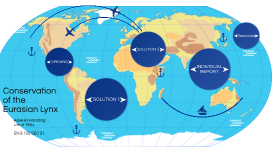
Transcript: Conservation of the Eurasian Lynx Alperen Karadag Umut Yıldız ENG 102 SEC 21 OPENING Research Question What measures can be taken to stop the illegal poaching of the Eurasian Lynx in Eastern Anatolia? Thesis Statement The poaching of Eurasian lynxes in the Eastern Anatolia region of Turkey is serious problem that needs to be addressed. Thankfully, there are existing solutions which aim to deal with this problem. Solution 1: Anatolian Lynx Project SOLUTION 1 Aim Activities This project aims to form an extensive baseline for conservation of the Eurasian lynx population in Turkey. Camera Trapping Faecal Sampling Documentary Production Informing the National Ministry Establishing an NGO Eurasian lynxes were successfully monitored. Reports were given to the Directorate of Nature Conservation and National Parks. Important initiatives towards conservation were put in place. Results Solution 2: 3Lynx SOLUTION 2 Aim of the Project Estabilishing a transnational common ground for lynx monitoring and management Development of transnational lynx conservation strategy on population level Cooperation with stakeholders Aim Activities done Activities -Hard Samples- 1) Meetings with stakeholders 2) Setting up cameras -Soft Samples- 1) Creating databases Results obtained Results What we have done INDIVIDUAL REPORT Resources Resources Czech Ministry of Environment et.al. (2020). Conservation Strategy for the Bohemian-Bavarian-Austrian Lynx population. Prague. 104 pages. Mengüllüoğlu D, Ambarlı H, Berger A, Hofer H (2018): Foraging ecology of Eurasian lynx populations in southwest Asia: Conservation implications for a diet-specialist. ECOL EVOL 8, 9451–9463. doi:10.1002/ece3.4439 Mengüllüoğlu D, Fickel J, Hofer H, Förster DW (2019): Non-invasive faecal sampling reveals spatial organization and improves measures of genetic diversity for the conservation assessment of territorial species: Caucasian lynx as a case species. PLOS ONE 14, e0216549. doi:10.1371/journal.pone.0216549 Mináriková T., Woelfl S., Belotti E., Engleder T., Gahbauer M., Volfová J., Bufka L., Poledník L., Schwaiger M. , Gerngross P. , Weingarth K. , Bednářová H. , Strnad M. , Zápotočný S. , Heurich M. & Poláková S (2020). Lynx Monitoring Report for BohemianBavarian-Austrian lynx population for Lynx year 2017 (2nd ed.). 20 pp. Report prepared within the 3Lynx Project, funded by INTERREG Central Europe. https://programme2014-20.interreg-central.eu/Content.Node/3Lynx.html Any Questions? End

Now you can make any subject more engaging and memorable