You're about to create your best presentation ever

Free Stethoscope Powerpoint Template

Create your presentation by reusing a template from our community or transition your PowerPoint deck into a visually compelling Prezi presentation.

Free Coral Reef PowerPoint Template

Transcript: Understanding Coral Reefs: The Rainforests of the Sea Coral reefs represent some of the most vibrant and biologically diverse ecosystems on the planet. Composed of calcium carbonate structures built by coral polyps, these underwater formations are essential for marine life and play a crucial role in ocean health. Their rich biodiversity supports countless species, making them vital to both ecological balance and human activities. Habitat for Marine Life Coral reefs serve as essential habitats for a vast array of marine species, including fish, invertebrates, and algae, supporting biodiversity and complex food webs. Coastline Protection Coral reefs protect coastlines by absorbing wave energy, reducing the impact of storms and preventing erosion, thus safeguarding coastal communities. Importance of Coral Reefs Support for Fishing Industries The fishing industry relies on healthy coral reefs for sustainable fish populations, which are crucial for food security and local economies. Contribution to Tourism Coral reefs attract millions of tourists each year, providing opportunities for recreation, education, and research, which boosts local economies. Biodiversity Hotspots Coral reefs support approximately 25% of all marine species, providing critical habitat and food sources for countless organisms. Economic Significance Conclusion The economic value of coral reefs is estimated to be over $375 billion annually, contributing to fisheries, tourism, and coastal protection. Conservation Importance Effective conservation strategies can help restore damaged reefs and enhance their resilience against climate change, ensuring their survival for future generations. Free Coral Reef PowerPoint Template A visually striking template designed for presentations on coral reefs and marine conservation. Utilizing the Coral Reef Presentation Template This template provides a structured approach to effectively communicate the importance of coral reefs. It features dedicated sections for essential facts, visuals, and timelines, making it easier to convey complex information clearly and engagingly. Timeline of Coral Reef Conservation Efforts Key initiatives and milestones in preserving coral ecosystems. Effects of Pollution and Overfishing Impact of Climate Change In addition to climate change, pollution from land runoff introduces harmful chemicals and sediment into marine environments, smothering corals and disrupting their delicate ecosystems. Overfishing and destructive fishing methods further exacerbate the decline of reef health, leading to imbalances in marine biodiversity. Coral reefs are increasingly endangered due to climate change, which causes rising ocean temperatures and leads to coral bleaching. This phenomenon occurs when stressed corals expel the algae living in their tissues, resulting in a loss of color and critical energy sources. 1990 2010 2020 2000 The establishment of the first marine protected areas to safeguard critical reef habitats. International agreements and partnerships formed to combat overfishing and promote sustainable practices. Restoration projects initiated to rehabilitate damaged coral reefs affected by bleaching events. Emergence of citizen science programs that engage local communities in coral monitoring and conservation efforts.

Stethoscope

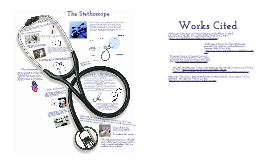
Transcript: The Stethoscope The stethoscope is an medical instrument used for listening to sounds inside the human body for diagnostic purposes. Until the stethoscope was invented, examination of patients was largely limited to external observations making it a very important technological invention. History 1816 - First Stethoscope invented in Paris, France by René Laennecin. Made of wood. It was monaural or had one ear pice 1829 - First flexible stethoscope described. 1851 - Irish physician Arthur Leared invented a binaural stethoscope or two earred. 1852- George Cammann perfected the design of the binaural for commercial production. 1940 - Rappaport and Sprague design a new stethoscope, which becomes the standard by which other stethoscopes are measured. It consists of two sides, one for the respiratory system, the other for the cardiovascular system. 1960 - David Litman creates a new and improvied lighter stethoscope with better acoustics. Became the standard for stethoscopes today. Why so Important? -Stethoscopes are so important because they are used to detect and study heart, lung, stomach, and other sounds in humans and animals. -Using the stethoscope, the listener can hear abnormal respiratory, cardiac, uterine, fetal, intestinal sounds and more! -Even with the development of recent technology the stethocope remains widely used because of it's simplicity and accuracy. Parts of a Stethocope Acoustic vs. Electronic -Acoustic stethoscopes are the ones familiar to most people, and work by the travel of sound from the chestpiece from the air-filled hollow tubes, to the listener's ears. -The chestpiece usually has two sides that can be placed against a person for sensing sound, a diaphragm (bigger plastic disc) or bell (smaller hollow cup). -If the diaphragm is placed on a person, body sounds vibrate the diaphragm, creating acoustic waves which travel up the tubing to the listener's ears. -If the bell is placed on the patient, the vibrations of the skin directly produce acoustic waves traveling up to the listener's ears. The bell transmits low frequency sounds, while the diaphragm transmits high frequency sounds. -Acoustic stethoscopes are the most commonly used. Electronic stethoscopes are much less common and work by overcoming the low sound levels by amplifiying body sounds. -Electronic stethoscopes require conversion of acoustic sound waves to electrical signals which can then be amplified and processed for much better listening. Other Stethoscopes A fetal stethoscope or fetoscope - an acoustic stethoscope that is placed against the abdomen of a pregnant woman to listen to the heart sounds of the fetus. Recording Stethoscope - an electronic stethoscope that features a direct audio output and can be connected to a laptop or other external recording device Although advanced diagnostic tools such as CAT scans, ultrasound technology and more have made the stethoscope look much less important... From all the way back to the 1800's... To modern day society... The stethoscope remains a valuable and widely used instrument and it's truly a sound technology that we could not live without. Works Cited "Stethoscope | Definition and Patient Education | Healthline." Medical Information for Healthy Living | Healthline. Web. 10 Jan. 2012. <http://www.healthline.com/galecontent/stethoscope>. "Stethoscope, Information about Stethoscope." Internet FAQ Archives - Online Education - Faqs.org. Web. 10 Jan. 2012. <http://www.faqs.org/health/topics/28/Stethoscope.html>. "Stethoscope Help Desk - Stethoscope Frequently Asked Questions." Stethoscope Sale - 3M Littmann Stethoscopes & Ultrascope Stethoscopes. Web. 10 Jan. 2012. <http://www.mystethoscope.com/help.php>. "Stethoscope: Why Choose Littmann Stethoscopes for Medical School?" David Gregory For Your Delectation | Mr G Spot On. Web. 10 Jan. 2012. <http://www.davidgregory.org/medical/stethoscope.htm>. 3M Littmann Stethoscopes: History of the Stethoscope: US." 3M Global Gateway Page. Web. 10 Jan. 2012. <http://solutions.3m.com/wps/portal/3M/en_US/3M-Littmann/stethoscope/littmann-learning-institute/about-stethoscopes/stethoscope-history/>. (Bell and Diapraghm)

Stethoscope

Transcript: My 19th Century Project The Stethoscope By; Natalie Olsen Overview of Invention Overview of the Invention The first stethoscope was made in France in 1816 by René Laennec. The invention made so listening to the heart and chest was easer, it is also used to hear blood flow noises in arteries and veins. It was invented because René Laennec was uncomfortable placing his ear on women's chests to hear heart sounds. The stethoscope was used by doctors and nurses. So they could find health problems easer. It works by funnling the sounds up the tube into the doctors ear. Inventor Rene Theophile Hyacinthe Laënnec Rene Laënnec was born in Quimper, France and lived from 1781–1826. When Laënnec was five years old his mother Michelle Félicité Guesdon, died from tuberculosis, leaving Laënnec and his brother, in the care of their father. His father was a servant so he was never around, so he was sent to live with his uncle. His uncle was the dean of medicine at the University of Nantes. So under his watch he started medical studies. The Invention Then Back Then The Stethoscope helped people by making it easer for doctors to see what is wrong with that person on the inside. The impact of the Stethoscope was very important. It helped doctors see sooner if the person had any issues in their stomach, lungs, heart or with the blood flow. So it helped the world by helping the docyors out. The Invention Now Now The Stethoscope is still used today in health today. Our world is different because it has inproved our ways toimprove health. All though it has had some changes. For example the shape is different. Also the way we hear it is different an better. Now instead of have to stick your ear up to the end of the tube you can hear it better because you stick the two end pices into your ear so its clear. Now Then In the middle Resources 1. https://www.adctoday.com/learning-center/about-stethoscopes/history-stethoscope 2. https://www.britannica.com/biography/Rene-Laennec 3. https://ceufast.com/blog/evolution-of-the-stethoscope I chose these sites because they had good pictures and all the information was laid out good and easy to find.

Stethoscope

Transcript: Stethoscope Rene was watching kids play with a hollow sticks! Then he notices that sound is amplified through the stick! The first stethoscope looked like a wooden tube where on one side you put on the patients chest and the other side goes to the doctors ear! Now they have stethoscopes that have two earpieces and can amplify the sound really loud! Difference Maker Sources The doctor could listen to the patients chest and not get body contact! Instead of the doctor putting a cloth on the patients body then listen to the patients heart like that they just use the tube so the doctor does not have to touch the patient! The doctors can go listen the patients heart and lungs! When the doctor examines the heart he can find where the exact problem is, so when there is a problem the doctor will know what the problem is and where the problem is! Summary of Invention Inventer & Date * Science Museum/Science & Society Picture Library * http://www.sciencemuseum.org.uk/images/I018/10284184.aspx * http://www.wisegeek.com/who-created-the-first-stethoscope.htm *http://themitralvalve.org/mitralvalve/rene-theophile-hyacinthe-laennec-1 * http://www.littmann.com/wps/portal/3M/en_US/3M-Littmann/stethoscope/littmann-learning-institute/about-stethoscopes/stethoscope-history/ *http://antiquescientifica.com/archive11.htm The first stethoscope was created in 1816 by a physician from Paris, France called Rene Theophile-Hyacinthe Laennec! Rene's invention oped up a new era in cardiology! 25 years later, George P. Cammann invented the first stethoscope with two ear pieces. Then in the 1960's Dr. David Littmann improveds the hearing of the stethoscope!

stethoscope

Transcript: whats a stethoscope Imhotep by:Edwin Lasagna why are they useful? sites history of the stethoscope Imhotep was an official during the 3rd Dynasty and served under four kings. He is best known for his position as vizier and high priest of Ptah during the reign of Djoser I. Imhotep was a commoner by birth, but rose through the ranks with his natural talents and dedication. Imhotep was called the "Son of Ptah" but didn't limit himself to religious matters alone. He was a very good poet, architect, and priest-physician. The greatest achievement of Imhotep is the Step Pyramid at Saqqara. He built this pyramid for Djoser, but it became an architectural model for the spiritual ideals of the people of Egypt. A stethoscope is a medical instrument for listening to the action of someone's heart or breathing, typically having a small disk-shaped resonator that is placed against the chest and two tubes connected to earpieces. Born: c. 3000 B.C.E. Ankhtowe, Egypt Died: c. 2950 B.C.E. Memphis, Egypt It is often used to listen to lung and heart sounds. It is also used to listen to intestines and blood flow in arteries and veins. who is Imhotep stethoscope the stethoscope was invented by Imhotep in ancient Egypt http://imhoteps_chamber.tripod.com/imhotep.html www.sixpartswater.org www.encyclopedia.com http://www.google.com/search?q=why+are+stethoscopes+used+for&oq=why+are+stethoscopes+used+for&aqs=chrome..69i57.24835j0j7&sourceid=chrome&es_sm=93&ie=UTF-8&gws_rd=ssl http://www.notablebiographies.com/Ho-Jo/Imhotep.html stethoscope Imhotep

Now you can make any subject more engaging and memorable