Key Takeaways
- "AI tools for trainers" means software that helps corporate L&D professionals plan, structure, design, and deliver training content faster, not technology that replaces the trainer.
- This guide is written for three groups: enterprise corporate trainers running 10+ sessions a month, L&D specialists and instructional designers, and freelance trainers or consultants serving multiple clients.
- The three main deck-builder categories are full-service AI presentation platforms (e.g., Prezi AI), AI-enhanced traditional tools (e.g., PowerPoint with Copilot, Google Slides with Gemini), and specialized instructional-design builders focused on learning outcomes.
- For compliance or technical training content, prioritize tools with strong source-document parsing, brand and terminology controls, and built-in accessibility support.
- Industry surveys put realistic time savings from AI-assisted deck production in the range of 40 to 70 percent depending on workflow stage, with content structuring and visual design seeing the biggest gains (see Methodology below for sourcing).
- Built-in audience interactivity, such as live polls, quizzes, and real-time Q&A, measurably improves retention over passive slide delivery and is worth weighing alongside design and brand features when you choose a tool.
- AI does not replace trainers. It removes the repetitive production work so trainers can spend more time on facilitation and learner engagement.
What Are AI Tools for Trainers in 2026?
AI tools for trainers are software applications that use artificial intelligence to help learning and development professionals create presentations, structure content, and design training materials more efficiently. They analyze source material, suggest a logical flow, generate visuals, and automate formatting, and they amplify a trainer's expertise rather than replacing it.
The term causes confusion because "AI trainer" also describes a career path: a person who trains AI models by labeling data or giving feedback on outputs. That role is distinct from a corporate trainer who uses AI-powered software to build training decks. This article is about the latter.
Glossary
| Term | What it means | Common aliases |
|---|---|---|
| AI deck builder | Software that generates slide structure, copy, and visuals from a prompt or uploaded document | AI presentation generator, prompt-to-deck tool, slide maker AI |
| AI trainer (job) | A person who trains or fine-tunes AI models, unrelated to corporate training | AI model trainer, RLHF trainer, data labeler |
| Instructional design features | Capabilities that structure content for learning outcomes rather than just visual appeal, such as objective alignment or knowledge checks | learning design tools, ID features |
| Prompt-to-deck | Generating a full slide deck from a written description of topic, audience, and goal | text-to-presentation, AI slide generation |
How Does AI Fit into the Modern Training Workflow?
AI supports four stages of training program development: content planning, deck creation, visual design, and delivery with analytics. It handles the repetitive middle steps so trainers can spend more time on the parts that require judgment.
Content planning and research. AI tools can scan source documents, pull out key themes, and propose learning objectives, which is especially useful with dense technical or regulatory material.
Deck creation and structure. Given a topic or an uploaded file, these tools generate a slide outline and first-draft copy in minutes rather than hours. The trainer then reviews and adds subject-matter expertise.
Visual design and polish. AI manages layout, color, image selection, and consistency across slides, which matters most for trainers without a design background.
Delivery and analytics. Some platforms track which slides hold attention and surface suggestions for the next session, turning past delivery into input for future decks.
The move to virtual and hybrid delivery has pushed more trainers toward these tools, since online sessions demand different pacing and visual density than in-person ones.
Which AI Deck Builders Fit Enterprise L&D vs. Freelancers?
The right category depends on volume, brand governance needs, and how much manual design control you want to keep. Three categories cover most trainer use cases: full-service AI platforms, AI-enhanced traditional tools, and specialized instructional-design builders.
Full-service AI presentation platforms handle the entire process, from a prompt or uploaded document to a finished, designed deck. They suit trainers producing high volumes of material who want consistent visual quality without building slide by slide.
AI-enhanced traditional tools add AI features to interfaces trainers already know, which suits teams standardized on a particular ecosystem who want assistance without switching tools entirely.
Specialized instructional-design builders focus on learning principles rather than visual polish alone, often including features like knowledge-check generation and objective alignment.
Comparison at a Glance
Feature sets and policies change frequently, so treat this as a starting point and confirm current details directly with each vendor before making a decision.
| Tool | Category | Best for | Collaboration | Brand control | Export / LMS | Accessibility aids | Audience interactivity |
|---|---|---|---|---|---|---|---|
| Prezi AI | Full-service | Fast prompt-to-deck production with brand consistency at scale | Chat-based refinement, shared workspaces | Your Designer brand layer, Smart Branding from a URL or logo | Video export, shareable links, viewer analytics | Presenter notes generated for all slides | Native live polls, word cloud, quiz generation, ask-the-deck Q&A, live audience view |
| PowerPoint with Copilot | AI-enhanced traditional | Teams standardized on Microsoft 365 | Native Office collaboration | Organizational brand controls via Office | Deep LMS and SharePoint integration | Mature built-in accessibility checker | Basic native polling via Microsoft Forms (license-gated); full word-cloud and Q&A features still require a third-party add-in like Poll Everywhere or Mentimeter |
| Google Slides with Gemini | AI-enhanced traditional | Lightweight, real-time collaborative editing | Native Google Workspace collaboration | Basic theme controls | Google Workspace and Classroom integration | Manual accessibility review generally still needed | No native polling; relies on the Slido add-on for polls, word clouds, and live Q&A |
| Canva Magic Design | AI-enhanced traditional | Visually driven, marketing-adjacent training content | Team libraries and comments | Brand kit controls | PDF, PPTX export | Alt text support, manual contrast checks | Native Polls & Quizzes elements plus Canva Live for real-time audience Q&A and reactions |
| Gamma | Full-service | Quick, shareable interactive content | Comments and workspace sharing | Theme-level branding | PPTX/PDF export, live links | Basic accessibility features | No native polls or quizzes; interactivity comes from toggles, hyperlink previews, and embedded third-party tools |
| Beautiful.ai | AI-enhanced traditional | Consistent slide layouts with minimal manual design | Team libraries | Preset-level brand rules | PPTX/PDF export | Manual review recommended | No native audience interactivity |
| Pitch | Full-service | Startup and sales-adjacent deck workflows | Real-time multiplayer editing | Brand kits | PPTX/PDF export | Manual review recommended | No native audience interactivity |
| Plus AI (Google Slides / PowerPoint add-on) | AI-enhanced traditional | Teams that want AI generation inside a tool they already use | Native to whichever host app it's installed in | Inherits host app's brand controls | Inherits host app's export options | Inherits host app's accessibility tools | No native interactivity; pair with a polling add-in in the host app |
A note on this list: Tome, previously included in this category, shut down its presentation product on April 30, 2025, and the team moved to a different product line. It's been replaced here with Plus AI, which is a currently active option.
Pros, Cons, and Best-Fit Notes
- Prezi AI: Best for compliance-heavy or brand-governed decks produced at volume, and for sessions where live audience interaction matters. Strength: prompt-to-deck generation, a persistent brand layer, and native interactivity (polls, quizzes, ask-the-deck Q&A) without a third-party add-in. Trade-off: full value depends on setting up brand assets up front.
- PowerPoint with Copilot: Best for organizations with existing Microsoft infrastructure and accessibility mandates. Strength: the most complete built-in accessibility tooling. Trade-off: AI generation quality depends on Copilot licensing tier, and richer audience interactivity still needs a third-party add-in.
- Google Slides with Gemini: Best for lightweight, fast-turnaround collaborative editing. Strength: real-time multi-user editing. Trade-off: fewer AI-native design and accessibility features than dedicated platforms.
- Canva Magic Design: Best for visually rich content with strong existing brand assets and built-in audience engagement. Strength: large asset library plus native polls, quizzes, and live Q&A. Trade-off: less suited to dense technical or regulatory content.
- Gamma: Best for quick internal or client-facing shares. Strength: fast generation and clean sharing links. Trade-off: less mature enterprise brand governance than platform-first tools, and no native polling or quizzes.
- Beautiful.ai: Best for teams that want guardrails against inconsistent layouts. Strength: automatic layout correction. Trade-off: less flexible for highly custom instructional formats.
- Pitch: Best for smaller, fast-moving teams. Strength: real-time collaboration. Trade-off: fewer instructional-design-specific features.
- Plus AI: Best for teams that want AI generation without leaving Google Slides or PowerPoint. Strength: no new tool to learn. Trade-off: capabilities are capped by whatever the host app supports.
How Do You Choose the Right Tool for Your Training Role?
Match the tool to your content complexity, monthly volume, brand governance needs, review workflow, and whether you need engagement analytics.
Selection checklist
- Content complexity , Can the tool parse dense technical, legal, or compliance material without oversimplifying it?
- Monthly volume , Are you producing one deck a month or dozens? Higher volume favors full-service AI platforms.
- Brand governance , Do you need centralized brand enforcement across a team, or is individual customization acceptable?
- Collaboration and review , Does content pass through multiple stakeholders before it is finalized?
- Analytics needs , Do you need to know which slides hold attention after a session ships?
Role-to-recommendation guide
- Enterprise corporate trainer (10+ sessions/month): A full-service AI platform with brand governance, such as Prezi AI. Rationale: speed and centralized brand control both matter at this volume.
- L&D specialist or instructional designer: A full-service platform with strong version history and comment-based review, or an AI-enhanced traditional tool if your organization already standardizes on Microsoft or Google. Rationale: materials pass through multiple stakeholders before a presenter uses them.
- Freelance trainer or consultant: A full-service platform with fast brand switching between client engagements. Rationale: billable time depends on minimizing per-client setup work.
How Much Time Can AI Reasonably Save on a 20-Slide Deck?
Time savings vary by workflow stage, but multiple 2025 to 2026 industry surveys point to meaningful, measurable gains rather than marginal ones. In a late-2025 survey of learning and development professionals conducted by Synthesia, 88 percent of respondents said AI is already helping them produce learning content faster, with speed cited by 84 percent as the primary reason they adopted AI in their workflow. That matters because time is the resource L&D teams report lacking most: Training Magazine Network's 2025 Trends in Training report found nearly half of HR and L&D professionals expected a lack of time to build training programs to be their top challenge, a finding echoed in TalentLMS's 2026 L&D Report, where roughly half of surveyed employees and learning leaders said high workloads leave little room for training even when it's needed.
Applied to a typical 20-slide deck, the biggest reported time gains cluster around content structuring and visual design rather than final review, which still benefits from human judgment. Treat any specific percentage as directional, since it depends heavily on source material quality and how much brand customization is required.
What Audience Interactivity Features Improve Retention?
Live interaction, such as polls, quizzes, and real-time Q&A, keeps learners active during a session instead of passively watching slides, which is consistently linked to better retention than one-way delivery. For trainers, the practical question is whether these features live inside the deck builder itself or require a separate tool bolted on top.
Interactivity features to look for
| Feature | What it does | Why it helps retention |
|---|---|---|
| Live polls | Collects real-time audience responses during a session | Breaks up passive viewing and surfaces where the group actually stands on a topic |
| Word cloud | Aggregates open-ended audience input and displays common responses as they come in | Encourages participation from people who wouldn't otherwise speak up |
| Quiz generation | Automatically builds a short quiz from the deck's own content | Reinforces material immediately after it's presented, which supports recall |
| Live Q&A / ask-the-deck | Lets viewers ask questions and get answers grounded in the presentation content | Supports self-paced review for learners who need to revisit a point later |
| Presenter mode with live audience view | Shows who's in the session and tracks engagement in real time | Helps the trainer adjust pacing on the spot rather than after the fact |
Where to find it. Some full-service AI platforms build these features directly into the deck, so there's nothing extra to set up before a session. Others rely on third-party add-ins, such as pairing PowerPoint or Google Slides with a separate polling tool like Mentimeter or Slido, which works well but adds a setup step and a second login for the audience. Dedicated instructional-design builders vary widely here, so confirm native support rather than assuming it.
Prezi AI includes live polls, a word cloud tool, and quiz generation built directly from the deck's own content, along with an "Explain this to me" feature that lets viewers ask the deck questions and get answers grounded in what's already on the slides, useful for asynchronous or self-paced review after a live session ends. These sit alongside presenter mode and a live audience view, so a trainer can see engagement and adjust pacing without switching to another tool mid-session.
Will AI Replace Personal Trainers and L&D Professionals?
No. AI changes what trainers spend their time on, not whether trainers are needed. Training depends on reading a room, adapting explanations in real time, and building the trust that lets a learner admit confusion, none of which current AI replicates.
What AI does remove is the tedious production work: formatting, visual consistency, and restructuring content for different audiences. That work required human effort because no alternative existed, not because it demanded judgment. Freeing that time lets trainers focus on facilitation and relationship building.
"AI trainer" as a job title usually refers to someone who trains AI models, a distinct and separate career path from an L&D professional who uses AI tools. Both roles are growing, but they answer different questions. For L&D professionals, the more useful question isn't whether AI replaces them. It's how using AI well makes them more valuable.
How to Create a Training Deck with AI in 6 Steps
- Write a prompt describing your topic, audience, and goal. (1 to 2 minutes) Be specific about session length and learner seniority to get a more usable first draft.
- Upload source material such as a policy PDF, SOP, or existing slide deck. (1 to 2 minutes) The AI extracts key content and uses it as the foundation instead of starting from a blank slide.
- Review the generated structure and flag gaps. (5 to 15 minutes) Check sequencing and flag anything the AI oversimplified, particularly compliance language.
- Apply your brand. (1 to 5 minutes, one-time setup per brand) With a saved brand profile, colors, fonts, and visual style apply automatically to every new deck.
- Generate presenter notes for all slides. (Under 1 minute) Gives any facilitator, not just the deck's author, a ready-to-use script.
- Ship the deck and iterate from analytics. (Ongoing) After delivery, review which slides held attention and ask the AI to suggest edits based on that data before the next session.
Prompt Starters for L&D Scenarios
Copy and adapt these as a starting point, then refine based on your source material and audience.
- "Summarize this policy PDF into a 12-slide compliance deck for [audience]. Flag any section where you had to simplify legal language."
- "Generate a role-play scenario deck with three branching decision points for a [topic] training, aimed at [audience seniority]."
- "Adapt this technical SOP into a 15-minute microlearning presentation with a knowledge check every 3 to 4 slides."
- "Rewrite this 40-slide deck for a [new audience, e.g., new managers vs. senior leaders], keeping the core content but adjusting tone and depth."
Quality-assurance checklist before you present
- Accuracy: Does every compliance or technical claim match the source document exactly, with no AI-introduced simplification that changes meaning?
- Assumptions labeled: Did the AI infer anything not stated in the source material? Flag it for the presenter.
- Accessibility: Do all images have alt text, and does color contrast meet WCAG 2.1 AA guidance? This is a real compliance question in some regions: the European Accessibility Act, harmonized with WCAG 2.1 AA, has been in force since June 28, 2025, and U.S. Title II ADA rules set an April 2026 compliance deadline for covered public entities.
- Tone: Does the language match the audience's seniority and familiarity with the topic?
- Data handling: If source material includes sensitive or proprietary content, confirm the platform's policy on whether uploaded content is used to train external AI models before uploading it.
Start Building Smarter Training Decks with Prezi AI
Building smarter training decks starts with tools that understand how trainers actually work. The goal isn't just faster production. It's better presentations that engage learners and communicate complex ideas clearly.
Prezi AI is built for this. With prompt-to-deck generation, you describe your training topic, audience, and goals, and Prezi AI produces a complete, design-ready presentation in seconds. Upload a PDF, Word doc, or PowerPoint file and Prezi AI reads it, extracts the key content, and uses that as the foundation, so there's no blank-slide starting point and no manual formatting.
Once your deck exists, chat-based refinement keeps everything in one place. Describe a change in natural language and Prezi AI applies it across the relevant slides, with full context from what you've already built. Need to shorten a section, adjust tone for a different audience, or swap an image? One conversation handles it. The Ask AI text tools let you shorten, expand, simplify, or convert paragraphs into bullet points directly in the editor.
For training teams producing content at scale, Prezi AI generates custom AI images for every slide based on your content and prompt, so you're not searching stock photo libraries for something that fits. Presenter notes generate for all slides at once, giving any facilitator a ready-to-use script. Version history lets you browse and restore previous drafts from the chat sidebar, useful when materials go through multiple rounds of stakeholder review.
For organizations with brand requirements, Your Designer is Prezi AI's brand-trained presentation layer. Set your brand once, colors, fonts, and visual style, and every deck your team produces comes out on-brand by default, with no central design oversight required. Smart Branding can extract colors and fonts directly from a website URL or an uploaded logo and apply them automatically.
For live sessions, Prezi AI includes native audience interactivity: run live polls and collect open-ended input through a word cloud, generate a quiz from your own slide content on the spot, and let viewers use "Explain this to me" to ask the deck questions and get answers grounded in what's already presented, useful for learners reviewing material after the session ends. Presenter mode shows a live audience view so you can see who's in the room and adjust pacing in real time, all without switching to a separate polling tool.
For trainers who want to measure impact, Prezi AI viewer analytics shows who viewed a shared deck, when, and for how long. Ask the AI to generate a report on your viewing data, identify what's working, and make edits directly from the analytics conversation.
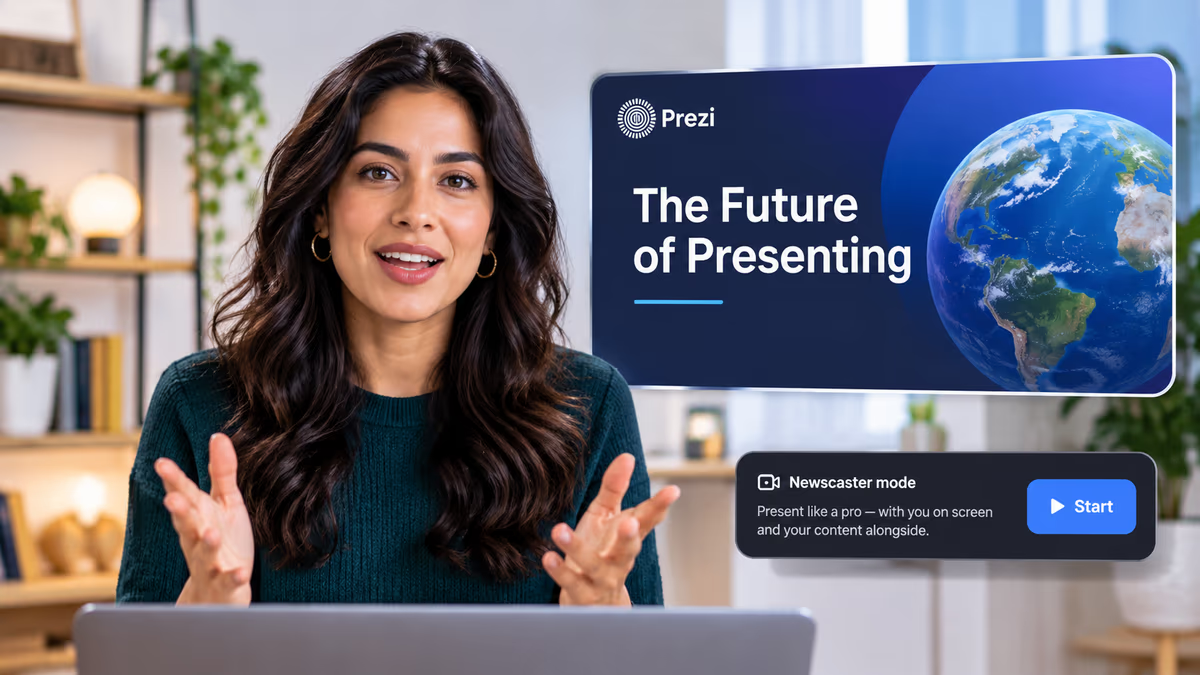
For content that needs to reach learners asynchronously, Prezi AI's narrated video feature generates a video version of any deck, complete with animation and AI voiceover, that you can export and share. Prezi Video also lets trainers appear alongside their content during live sessions without a green screen, which works well for remote and hybrid delivery.
Methodology (Updated August 2026)
Tool categories and comparison notes, including audience interactivity features, reflect publicly available product information as of August 2026. Time-savings and workload figures cite third-party L&D industry surveys published in late 2025 and early 2026 (Synthesia's AI in Learning & Development Report, Training Magazine Network's Trends in Training Report, and TalentLMS's L&D Report). Accessibility guidance reflects current W3C WCAG 2.1/2.2 standards and the European Accessibility Act's June 2025 enforcement date. Vendor features change quickly; confirm current capabilities directly with each provider before making a purchasing decision.
Frequently Asked Questions
What are AI tools for trainers? AI tools for trainers are software applications that use artificial intelligence to help learning and development professionals create presentations, structure content, and design training materials more efficiently. They automate time-consuming tasks like slide layout, visual design, and content organization, letting trainers focus on facilitation and learner engagement.
How can AI tools help trainers save time on presentations? By automating the most repetitive parts of deck production. Prompt-to-deck generation produces a complete, design-ready deck in seconds from a topic description or uploaded file, and chat-based refinement lets trainers describe changes in natural language instead of rebuilding slides manually. Trainers running multiple sessions monthly often reclaim hours that go toward learner interaction instead.
What should trainers look for when choosing an AI deck builder? Look for a tool that handles your specific content complexity, integrates with your existing workflow, and produces outputs matching your quality bar. Key factors: how well it processes dense or technical source material, whether it supports brand customization, how much design control it offers, and whether it fits your team's collaboration and analytics needs.
Will AI replace personal trainers and corporate facilitators? No. Training depends on human connection, adaptability, and real-time responsiveness that AI doesn't replicate. AI replaces the repetitive production tasks, not the facilitation and relationship-building that make training effective.
Is being an AI trainer a real job in 2026? Yes, but it refers to professionals who train AI models, providing feedback, labeling data, and helping models improve, not trainers who use AI tools to build content. It's a distinct career path from corporate trainers or L&D professionals.
Can AI generate a full training deck from scratch? Yes. Given a prompt or uploaded source material, Prezi AI can produce a structured outline, slide copy, presenter notes, and visual layout in one pass. Treat the result as a strong starting point that benefits from human review, particularly for compliance accuracy, rather than a finished deck ready for immediate delivery.
What's the difference between an AI presentation tool and a traditional deck builder? AI presentation tools automate content structuring, design decisions, and visual consistency from a prompt or uploaded file. Traditional deck builders require manual input for every element. AI tools prioritize speed and consistency; traditional tools offer more manual control for people who prefer hands-on design work.