You're about to create your best presentation ever

Quiz Template Presentation

Create your presentation by reusing one of our great community templates.

Quiz Show Template

Transcript: Question 1.2 (2 points) This question is part of the quiz show template and falls under the Literature category. Participants will earn 2 points for answering correctly. Understanding Newton's Second Law of Motion Question 1.1 (1 point) This question tests basic geographical knowledge, suitable for beginners. Participants will identify the capital city of France, which is a common knowledge question. Newton's second law of motion states that the force acting on an object is equal to the mass of that object multiplied by its acceleration. This fundamental principle explains how the velocity of an object changes when it is subjected to an external force. Photosynthesis: The Key to Plant Nutrition Photosynthesis is the process by which green plants, algae, and some bacteria convert light energy into chemical energy, producing glucose and oxygen from carbon dioxide and water. This essential process not only fuels plant growth but also supports life on Earth by generating the oxygen we breathe. Question 2.1 (1 point) This question is part of a quiz show template, focusing on basic knowledge. Participants can answer this fundamental science question for 1 point. Questions on Biology, Chemistry, and Physics This category features a range of questions that test your knowledge of biology, chemistry, and physics. Each question is designed to challenge participants at varying levels of difficulty, with points awarded based on complexity. Challenge Your Understanding of Science Category 2: Science Question 2.2 (2 points) Expect to encounter questions that delve into key concepts, theories, and experiments across scientific disciplines, making it essential to have a solid understanding of science. Identify the chemical symbol that represents the element gold. This question is worth 2 points and falls under the category of elements in the periodic table. Interactive Question Mechanism Each question can be clicked on to zoom in and reveal more details, allowing participants to focus on the question and answer options before making their choice. Points Based on Difficulty Engaging Fun Trivia Variety of Questions Points are awarded based on the complexity of the questions, encouraging contestants to challenge themselves and aim for higher scores. Incorporate fun trivia to keep the audience and participants engaged and entertained throughout the quiz show. This category features a diverse range of questions that test participants' knowledge across various subjects, including history, geography, science, and pop culture. Question 1.3 (3 points) This question tests knowledge of the solar system's planets. The answer reveals key facts about planetary sizes and characteristics. Question 1.4 (4 points) Category 1: General Knowledge This question is part of the history category of the quiz show, testing knowledge on significant events. Participants will earn 4 points for correctly answering this moderately difficult question. Explore Significant Historical Events This category challenges participants to recall pivotal moments in history, encouraging a deeper understanding of the events that shaped our world. Introduction to the Quiz Show Famous Figures and Their Impact Category 3: History Questions will focus on renowned historical figures, their contributions, and the impact they had on society. Participants must recognize key players in history. Test Your Knowledge of Dates Get ready to test your knowledge in a thrilling quiz format! Choose from four diverse categories, each featuring 4 to 5 questions that vary in difficulty and points awarded. Participants will be tested on important dates that marked historical milestones, enhancing their ability to connect events with the appropriate timeline. Question 3.1 (1 point) Identify the first President of the United States, a significant figure in American history. This question tests basic knowledge of U.S. political history. Question 3.2 (2 points) This question tests the participant's knowledge of significant historical events. Answering correctly rewards 2 points, encouraging engagement with the topic. Quiz Show Template Question 3.3 (3 points) This question tests knowledge about influential political figures. The answer highlights a significant leader known for her strong will and decisive actions. Question 4.1 (1 point) This question tests knowledge of geography and oceanography. Participants need to identify the largest ocean on Earth, which is critical for understanding global water systems. Countries and Capitals Quiz Test your knowledge of world countries and their capitals with multiple choice questions that increase in difficulty. Each correct answer earns you points based on the challenge level. Landmarks Challenge Identify famous landmarks from around the globe with questions that vary in point value. The more obscure the landmark, the higher the points awarded for a correct answer. A structured template featuring four quiz categories with adjustable difficulty and

Trivia Quiz Template

Transcript: Authorship of 'Romeo and Juliet' Introduction to the Trivia Template Example Question 2 William Shakespeare, a prominent English playwright and poet, is widely regarded as the author of 'Romeo and Juliet,' a timeless tragedy that explores themes of love and conflict. This trivia template is designed to engage participants through 20 carefully crafted questions, each accompanied by four answer options labeled A, B, C, and D. It serves as a framework for creating fun and educational trivia games. Questions and Answer Options Clarity and Engagement Engaging and Educational Example Question 1 The trivia template includes a total of 20 questions, each designed to engage participants with diverse topics. Each question is structured with four possible answers, labeled A, B, C, and D, ensuring clarity and ease of understanding. This formatted approach allows for straightforward responses, making it easy for participants to select their answers. The inclusion of plausible distractors alongside the correct answer helps to maintain challenge and engagement throughout the trivia game. Trivia games are effective tools for fostering knowledge retention through engaging gameplay, making learning enjoyable and memorable. Versatile Usage Purpose of Trivia Clarity is Key in Question Design These games can be utilized in diverse environments including classrooms, family gatherings, corporate events, and social gatherings, ensuring a broad applicability. This question tests geographical knowledge by asking for the capital city of France, with multiple-choice options to choose from. To enhance participant engagement and understanding, each trivia question must be phrased clearly and concisely. This ensures that everyone can easily grasp what is being asked without confusion. Promotes Social Interaction By integrating trivia into events, participants are encouraged to engage socially, fostering teamwork and collaboration among players. Plausible Options The answer options must be carefully crafted to avoid obvious incorrect choices, ensuring that participants must think critically to select the correct answer. Crafting Effective Answer Options Single Correct Answer Only one answer option should be correct, which maintains the integrity of the trivia game and encourages participants to refine their decision-making skills. Encouraging Critical Thinking Importance of Interest and Relevance Incorporating critical thinking elements in questions challenges participants to analyze and reflect, rather than simply recall information. This can lead to deeper discussions and a more rewarding trivia experience. Questions must be crafted to capture the participants' interest, making them curious and eager to respond. Relevance to the audience's experiences or current trends can enhance engagement and participation. Example Question 3 This question assesses knowledge of the solar system, specifically identifying the largest planet among the options provided. The correct answer is B) Jupiter, which is known for its massive size and distinctive features such as its Great Red Spot. Example Question 5 This question tests knowledge of a significant historical event, specifically the sinking of the Titanic, which occurred in 1912. The answer options provide plausible distractors to challenge participants' knowledge. Oxygen is 'O' Chemical Element with Symbol 'O' Oxygen is essential for life and is the most abundant element in the Earth's crust. It plays a crucial role in respiration for living organisms and is a key component of the water molecule. Trivia Quiz Template Assess Knowledge Retention Trivia serves as an effective tool for assessing knowledge retention across a wide array of subjects, making it suitable for various learning environments. Identify Knowledge Gaps The Role of Trivia in Knowledge Testing Engaging in trivia can identify areas where participants may lack understanding, fostering an opportunity for targeted learning and improvement. Promote Lifelong Learning In addition to providing a fun experience, trivia encourages participants to explore subjects in greater depth, promoting lifelong learning habits. A comprehensive template for crafting engaging trivia questions and answers Implementing a Scoring System for Trivia A scoring system is essential for tracking correct answers and determining winners in trivia games. Each correct answer can be assigned a specific point value, and participants' scores can be tallied to evaluate their performance. This not only adds a competitive element but also enhances engagement and motivation among players. Engage in Discussion This session invites participants to ask questions and share insights regarding the trivia template. It is an opportunity to clarify any doubts and discuss practical applications. Create Your Questions Now Begin developing your trivia questions using the provided template. Each question should have four answer options (A, B, C, D) to encourage critical thinking and

Presentation template

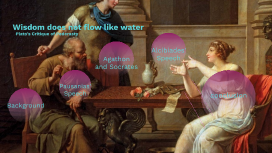
Transcript: Wisdom does not flow like water Plato’s Critique of Pederasty Pederasty Background Symposium Pederasty My Project Pausanias' Speech Pausanias' Speech Two Aphrodites Uranian Heavenly Pandemos Common Text Text Pictures Pictures "Here, Socrates, lie down alongside me, so that by my touching you, I too may enjoy the piece of wisdom that just occurred to you while you were in the porch. It is plain that you found it and have it, for otherwise you would not have come away beforehand." Agathon and Socrates “It would be a good thing, Agathon, if wisdom were the sort of thing that flows from the fuller of us into the emptier, just by our touching one another, as the water in wine cups flows through a wool thread from the fuller to the emptier. For if wisdom too is like that, then I set a high price on my being placed alongside you, for I believe I shall be filled from you with much fair wisdom. My own may turn out to be a sorry sort of wisdom, or disputable like a dream; but your own is brilliant and capable of much development, since it has flashed out so intensely from you while you are young; and yesterday it became conspicuous among more than thirty thousand Greek witnesses." "You are outrageous, Socrates," Agathon said. "A little later you and I will go to court about our wisdom, with Dionysus as judge, but now first attend to dinner." how water flows Principle at play When they do engage in a contest about love Timeline YEAR Alcibiades' Speech Socrates, he claims, is like “those silenuses that sit in the shops of herm sculptors, the ones that craftsman make holding reed pipes or flutes; and if they are split in two and opened up they show they have images of gods within.” (215b) Alcibiades' Speech You, in my opinion,' I said, 'have proved to be the only deserving lover of mine; and it seems to me that you hesitate to mention it to me. Now I am in this state: I believe it is very foolish not to gratify you in this or anything else of mine—my wealth or my friends—that you need; for nothing is more important to d me than that I become the best possible; and I believe that, as far as I am concerned, there is no one more competent than you to be a fellow helper to me in this. So I should be far more ashamed before men of good sense for not gratifying a man like you than I should be before the many and senseless for gratifying you.' Seduction Scene 'Really, my dear Alcibiades, you're no sucker if what you say about me is really true and there is some power in me e through which you could become better. You must see, you know, an impossible beauty in me, a beauty very different from the fairness of form in yourself. So if, in observing my beauty, you are trying to get a share in it and to exchange beauty for beauty, you are intending to get far the better deal. For you are trying to acquire the truth of beautiful things in exchange for the seeming and opinion of beautiful things; and you really have in mind to exchange "gold for bronze." But blessed one do consider better: Without your being aware of it—I may be nothing. Thought, you know, begins to have keen eyesight when the sight of the eyes starts to decline from its peak; and you are still far from that.' Conclusion conclusion If Socrates were to have sex with Alcibiades, he would perpetuate: 1) the idea that people can make each other wise. impact: prevent Alcibiades from realizing his ignorance about wisdom 2) Alcibiades belief that his physical attractiveness is the most important thing about him impact: the belief could harm Alcibiades as he begins to decline from his physical peak, when “Thought begins to have keen eyesight.” (219a) 3) Socrates would be no better than the sophists who cannot acknowledge the ways in which they are ignorant, and thus, risk self-deception. Advantages Advantages to my account: -Fits with the well-known picture of a Socrates who: 1) proclaims his own ignorance. 2) critiques the Sophists for i. both not acknowledging what they do not know ii. exchanging money for wisdom -Makes explicit the way Plato critiques the customs of his time -Throws into question a vision of Socrates as someone who consistently denies bodily urges -Makes clear that the container model is supposed to function in opposition to the image of pregnancy and birth. Accounts of “Plato’s Appropriation of Reproduction” run these two images together.

Pub Quiz Template

Transcript: The Social Appeal of Pub Quizzes Pub quizzes are engaging events that blend entertainment with knowledge, allowing participants to connect with friends and enjoy a lively atmosphere. These gatherings not only test trivia skills but also enhance the overall pub experience with food and drinks. Thematic Rounds Fostering Community Through Pub Quizzes Pub quizzes serve as an excellent medium for social interaction and engagement, effectively uniting individuals over shared interests. Organizing your own quiz night can enhance community spirit and provide memorable experiences for participants. Each round of a pub quiz typically focuses on a specific theme, such as movies, music, or current events, allowing for varied topics and engagement. Diverse Question Formats Structure and Format of Pub Quizzes The inclusion of different question formats keeps the quiz dynamic and allows participants with various strengths to shine. This mix often includes multiple-choice, true/false, and open-ended questions. Time Frame The typical quiz lasts between 1.5 to 2 hours, making it a perfect after-dinner activity. This timeframe allows for breaks and socializing between rounds. Engaging Participants Interactive Rounds Prizes for Winners Themed Quizzes Pub Quiz Template Incorporating fun activities, like picture rounds or music rounds, encourages participation and keeps energy levels high. Themed quizzes can revolve around popular culture, holidays, or specific topics, attracting participants with shared interests. Offering prizes, whether they be gift vouchers or fun trophies, motivates participants to engage more fully in the quiz experience. A structured guide for crafting your own pub quiz experience. Mix of Questions Maintain a balanced variety of questions across different categories to cater to diverse interests and knowledge levels. This ensures that all participants can engage and enjoy the quiz. Popular Question Categories in Pub Quizzes Lively Atmosphere Tips for Hosting a Successful Quiz Create a fun and energetic atmosphere by using music, lights, and interactive activities. This will keep participants excited and motivated throughout the quiz. Encourage Teamwork History General Knowledge Entertainment Sports Geography History questions often involve significant events, dates, and figures from the past, appealing to history buffs. General knowledge questions cover a wide range of topics, testing overall trivia skills. Entertainment questions cover movies, music, and television, appealing to pop culture fans and trivia lovers alike. Sports questions engage fans with queries about teams, players, and events, perfect for sports enthusiasts. Geography questions test knowledge of countries, capitals, and landmarks, making them popular for travel enthusiasts. Encourage teamwork by allowing participants to form teams and discuss answers. This enhances camaraderie and makes the quiz more enjoyable for everyone. Scoring System in Pub Quizzes Understanding how points are awarded enhances the competitive spirit of the quiz. Complete Answers General Teams that answer all questions correctly may receive additional rewards, encouraging thoroughness and teamwork. Points are awarded for each correct answer, creating a straightforward scoring method. Bonus Points Difficult Questions Easy Questions Some quizzes offer bonus points for particularly challenging questions, adding an extra layer of excitement. Difficult questions challenge participants' knowledge and can involve obscure facts or specific details that are not commonly known. An example would be asking for the name of a lesser-known historical figure, which requires deeper knowledge and research. Easy questions serve as a great starting point for participants, often covering familiar topics or widely known facts. For instance, asking about the capital of France is straightforward and accessible for most quiz-goers.

Now you can make any subject more engaging and memorable