You're about to create your best presentation ever

Powerpoint Template Quiz Multiple Choice

Create your presentation by reusing a template from our community or transition your PowerPoint deck into a visually compelling Prezi presentation.

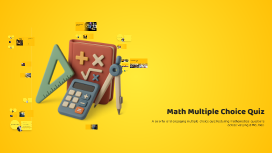
Math Multiple Choice Quiz

Transcript: Average Difficulty Questions In this section, you'll find questions that challenge your mathematical reasoning. Each question is designed to enhance your critical thinking skills and reinforce your understanding of mathematical concepts. Dividing by two concept Question 4 - Easy Question: What is 3 + 5? Question: What is 8 - 2? Correct answer is D) 9 Key arithmetic operation Question 5 - Easy What is 12 - 5? Question: What is 5 x 6? A) 6 Question: What is 20 ÷ 4? Basics of division skills Question 2 - Average B) 7 3 x 3 equals 9 Question: What is the sum of 10 + 10? Question 3 - Easy C) 8 Understanding fractions involved D) 9 What is the value of 7 + 8? An essential multiplication fact Question 1 - Average A) 14 Practice with similar questions What is 6 x 4? Question 3 - Average A) 20 B) 15 B) 22 C) 24 D) 26 C) 16 D) 17 Simple subtraction problem Question 2 - Easy Basic arithmetic skills test What is 36 ÷ 6? A) 5 Engages early learners Question 4 - Average B) 6 Encourages critical thinking C) 7 D) 8 Foundation for future math 30 Questions Total Timed Questions Multiple Choice Format Answers Revealed at the End The quiz consists of a total of 30 questions categorized by difficulty: 10 Easy, 10 Average, and 10 Hard questions. This structure allows participants to progressively challenge themselves as they go through the quiz. Each question is presented in a multiple-choice format with four options (A, B, C, D), making it easier for participants to select their answers without needing to write them down. Participants will have a limited amount of time to answer each question, ensuring a dynamic and engaging quiz experience. The time limit will be clearly displayed for each question. At the end of the quiz, participants will receive the correct answers for each question, allowing them to review their performance and learn from their mistakes. Quiz Format Overview Introduction to the Quiz This mathematics quiz consists of 30 questions divided into three difficulty levels: Easy, Average, and Hard, with 10 questions in each category. Prepare to engage your critical thinking skills and see how well you can perform under different levels of challenge! What is the square root? Question 5 - Average Understanding square roots concept Easy Difficulty Questions Square root applications in life These questions are designed to warm you up and get you comfortable with the quiz format. You'll find basic arithmetic questions that test fundamental math skills. Importance in higher mathematics What is 2 + 2? A) 3 Question 1 - Easy B) 4 C) 5 D) 6 Hard Difficulty Questions This section contains challenging questions designed to truly evaluate your mathematical abilities. Prepare to tackle complex calculations and problem-solving scenarios across various mathematical concepts. What is 15 + 27? A) 40 Question 1 - Hard B) 41 C) 42 D) 43 What is the cube of 3? A) 6 Question 4 - Hard B) 9 C) 27 What is 81 - 29? Question 2 - Hard D) 30 Math Multiple Choice Quiz A) 50 B) 51 What is 144 ÷ 12? Question 5 - Hard C) 52 A) 10 B) 11 D) 53 C) 12 D) 13 Correct answer is 81 A colorful and engaging multiple-choice quiz featuring mathematical questions across varying difficulties. 9 is a square number Question 3 - Hard Conclusion and Answers Multiplication tables essential Thank you for participating in our Mathematics Quiz! Below are the correct answers for each question across all difficulty levels. We hope you enjoyed testing your math skills and learned something new! Importance in advanced math

Quiz: Multiple Choice

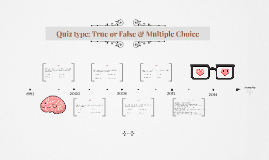
Transcript: 2006 A. Module 1993 2012 C. Constructors It is a grouping of subprograms that are logically related into a unit that can be separately combined. Methods that return the value of the field. Prefix the name of any method that returns a value with 'get'. A. Get/Set 05 It is a view or representation of an entity that includes only the most significant attributes. This concept is fundamental in programming. B. Destructors Multiple Choice 1.C 2.C 3.C 4.A 5.B B. Destructors D. Instance 2014 C. Abstraction B. Personal C. Return 02 03 Functions to clean up after an instances is destroyed; usually to reclaim heap storage. C. Constructors 2000 A. Module Write T if true or F is false. 1. Abstraction is a representation of an entity. 2. All subprograms are process abstractions. 3. Encapsulation is separating elements to create a larger entity. 4. The principle of information hiding is the hiding of design decisions in a computer program that do not change. 5. Getters are methods that gets the value of the field. 6. Constructos create objects. 7. Programs are composed of one or more independently developed modules that are combined until the program is linked. 8. A single module can only contain one routine. 9. The concept of Abstraction is fundamental in programming. 10. Two fundamental kinds of abstraction are process and data abstraction. A. Constructors Quiz type: True or False & Multiple Choice A. Private B. Encapsulation 04 True or False 1. t 2. t 3. f 4. f 5. f 6. f 7. f 8. f 9. t 10. t D. Constructor D. none of the above Which of the ff. does not belong to the specification package of Information Hiding D. Class C. Public 01 D. Encapsulation Answer Key B. Class

Multiple Choice

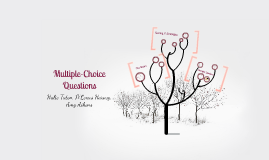
Transcript: There once was a man from Peru. He dreamed he was eating his shoe. He woke with a fright in the middle of the night, to find his dream had come true. Halie Tuten, D'Lexus Harvey, Amy Aikens Types of Multiple Choice Questions Straightforward question The question that refers you to specific lines and asks you to draw conclusions The "all...except" questions The question that asks you to make an inference or to abstract a concept that isn't directly stated in the question The killer question. The one that uses roman numerals. How to work through the questions Be expected to: Follow syntax Respond to diction Know upper-level vocabulary Be familiar with literary terms Recognize style, irony, and tone Questions you should expect: Factual Technical Analytical Inferential Survival Plan for if time is running out (pull from Pi) Q: In Life of Pi, Pi encounters I. a ship wreck II. loss of family III. 2 different religions Work in order (it'll be clearer and you won't lose your place on the scan sheet). Write on the exam booklet. Do not spend too much time on any one question Focus on your strengths (If you are comfortable with poetry, answer those questions first). Don't be mislead by the length or appearance of a selection. Consider all choices in a given question. Remember that all parts of an answer must be correct. When in doubt, go to the text. Multiple choice scores are based solely on the number of questions answered correctly. It makes up 45% of the total test. Scoring & Strategies Work at a pace of about 1 question per minute. The test doesn't become more difficult as you proceed. Read the text carefully. Highlight, underline, or circle the text as needed. Hear the words in your head, emphasize meaning and intent. Use all information given to you, such as title, author, and footnotes. Be aware of foreshadowing, thematic lines. With poetry, it's helpful to paraphrase a stanza. Specific Techniques A. I only B. I and II only C. all the above D. II only (Pull from Big Fish) Q: Edward Bloom was all of the following except: A. A sickly elder B. A great story teller C. A salesman D. Always honest Example Questions Prose passages come from: Fiction Nonfiction Drama The Basics "All...Except" Questions Process of elimination Substitution/fill in the blank Using context Anticipation Educated guess How does scoring work? Roman Numerals For this section,you are given 1 hour to answer between 45 to 60 questions on prose and poetry. What Should You Expect? Multiple-Choice Questions General Guidelines Straightforward Question Where was the man from? Argentina Peru Africa China Scan the remaining questions and look for: the shortest questions and ones that direct you to a specific line. Look for specific details/definition questions. Look for self-contained questions. ("The sea slid silently from shore" is an example of C, alliteration. You don't have to refer to the passage for the answer.)

Now you can make any subject more engaging and memorable