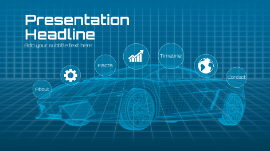
3D Car Presentation Template
Transcript: Key Features of the 3D Car Template Realistic Textures and Materials User-Friendly Interface Customizable Components Interactive Elements With high-quality textures and a variety of material options, the 3D Car Template enhances the visual fidelity of automotive presentations. Realistic finishes such as metal, paint, and glass contribute to a lifelike appearance, improving audience engagement. Interactive features such as 360-degree rotation, zoom, and clickable hotspots allow viewers to engage with the model in-depth. These elements facilitate a deeper understanding of the design and functionality of the vehicle. The template allows users to tailor car designs by modifying components such as body shape, wheels, and interior layouts. This customization enables designers to create unique models that meet specific branding and functional requirements. Designed prioritizing usability, the 3D Car Template offers an intuitive interface that simplifies navigation and manipulation of models. This ensures that users, regardless of their technical expertise, can effectively utilize the template for presentations. 3D Car Presentation Template Introduction to 3D Car Design Overview of 3D Design Technology Historical Evolution of Car Design Benefits of 3D Modeling in Automotive 3D modeling provides numerous advantages, including rapid prototyping, cost savings, and enhanced collaboration among teams. It allows for modifications to be visualized instantly, improving the overall efficiency of the design process. 3D design technology utilizes sophisticated software to create realistic models of vehicles. Tools like CAD (Computer-Aided Design) allow designers to manipulate components in a virtual environment, leading to innovative designs and precise specifications. The evolution of car design spans over a century, starting from simple prototypes to complex, aerodynamically optimized structures. Technological advances in materials and design techniques have continually reshaped the automotive landscape, converging toward 3D modeling. Showcasing Innovative Automotive Designs and Technologies Applications of the 3D Car Template Marketing and Advertising Utilizing 3D car templates in marketing presents an unparalleled opportunity to create visually stunning promotional content. 3D models provide a realistic representation of vehicles, enabling brands to showcase features and designs effectively across digital platforms and advertisements. Educational Purposes Concept Visualization 3D car templates enhance concept visualization by allowing designers and stakeholders to view and interact with models in real-time. This process supports better decision-making, ensuring that design intent aligns with functionality and aesthetics before physical prototypes are manufactured. In educational settings, 3D car templates serve as valuable tools for teaching automotive design and engineering principles. Students can manipulate models to understand complex concepts such as aerodynamics, structural integrity, and design aesthetics, fostering practical learning experiences. Prototyping and Development 3D car templates streamline the prototyping phase by facilitating rapid iterations and modifications. Designers can test various configurations and materials in a virtual environment, significantly reducing time and costs associated with traditional prototyping methods and enhancing overall product development efficiency. Case Studies and Examples Feedback from Industry Professionals Future Trends in 3D Automotive Design Successful Car Models Created in 3D Comparative Analysis of 2D vs 3D Presentations Companies like BMW and Ford have successfully utilized 3D modeling to create innovative car designs, enabling rapid prototyping and testing. The BMW i8, for instance, showcased a streamlined development process using 3D technologies, significantly reducing time to market. Studies reveal that 3D presentations are 30% more effective in communicating design concepts compared to 2D. The three-dimensional view allows for better comprehension of complex shapes and functionalities, greatly improving audience engagement. The future of 3D automotive design is leaning towards virtual reality (VR) and augmented reality (AR) integrations. These technologies will enable immersive experiences, allowing designers and clients to interact with car models in real-time, bringing about a new era of design collaboration. Industry experts emphasize that 3D car presentations enhance visualization, making it easier to convey design intent to stakeholders. Feedback indicates a clear preference for 3D models over traditional 2D sketches for presentations, leading to more informed decision-making.

 Prezi Present

 Prezi Video

 Prezi Design