You're about to create your best presentation ever

Electronic Poster Presentation Template

Create your presentation by reusing one of our great community templates.

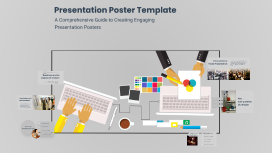
Presentation Poster Template

Transcript: Presentation Poster Template A Comprehensive Guide to Creating Engaging Presentation Posters Introduction to Poster Presentation A poster presentation is a visual communication tool used to convey information about a specific topic, research, or project. It serves as a vital method for sharing ideas and findings in academic and professional environments, allowing for engagement and discussion with the audience. "Questions are the engines of intellect." The Importance of Questions Title Abstract The abstract summarizes the key points of the research, providing a snapshot of the study's purpose, methods, results, and conclusion in a brief format. A concise and descriptive title serves as the first impression of your poster, capturing the essence of the research and engaging the audience's interest. Conclusion and Best Practices Introduction Methods Key Components of a Poster The introduction provides necessary background information that sets the context for the research, outlining its significance and objectives. The methods section details the approach and procedures followed during the research, allowing others to understand and replicate the study. Results Conclusion Creating an impactful poster presentation requires attention to both content and design. By focusing on essential elements and following best practices, presenters can effectively communicate their research and engage their audience. The results section highlights key findings, often using graphs, charts, or images for visual representation to make data easily digestible. The conclusion summarizes the main findings, discussing their implications and significance, and often suggests areas for future research. Overloading with text Poor image quality Common Mistakes to Avoid Inconsistent formatting Utilize ample white space Ignoring audience engagement Design Tips for Effective Posters Incorporate visual hierarchy Select appropriate fonts Limit color palette Use bullet points strategically

Electronic Poster

Transcript: Earth revolves around the sun once per year, the axis of rotation points in the same direction throughout the yearly year. The heat and solar energy provides a lot of things for the earth. Nutation It is the rotation of the solid Earth around its own axis. The main results of Earth's rotation are day and night. Earth's path about the galaxy The earth moves around the galaxy in a circular path around the sun. Precession Barycenter The seasons in the Southern Hemisphere and Northern Hemisphere are detewrmined by the amount of sunlight they get. The sun's energy affect food webs on earth. References Solar energy essential to plants The sun produce energy which is transferred to the earth by radiation. photo credit Nasa / Goddard Space Flight Center / Reto Stöckli A rocking swaying or nodding motion in the axis of rotation. The seasons in the southern heimisphere opposite to those in the northern hemisphere. The suns energy affects the food web because if the sun was not here everything that is living would die out at some point Revolution of the earth around the sun Are non-rotating cordinates with origin at the center of mass of two or more bodies. -Wikipedia -harunyahya.com -http://calgary.rasc.ca/howfast.htm -http://www.learner.org/jnorth/tm/ReasonsBack.html -http://apollo.lsc.vsc.edu/classes/met130/notes/chapter16/precession.html -http://christophercrockett.com/astrowow/obliquity/ -http://scienceprojectideasforkids.com/2010/barycenter-of-the-earth-moon-system/ -http://scienceblogs.com/startswithabang/2012/02/29/the-physics-of-leap-day/ -http://www.abcteach.com/documents/clip-art-world-map-northern-and-southern-hemispheres-color-40128 -http://www.danbury.k12.ct.us/elemweb/aaaoldElempages/sitesweb/foodweb/indexfoodweb.html - Electronic Poster Explain the rotation of the Earth Energy is essential to plants because solar energy comes from the sun and the sun helps things grow like plants A change in the orientation of the rational axis of a rotating body. Earth experiences precession because it undergoes gravity.

Electronic Poster

Transcript: Why Study History? Industrialization lead to large changes in education and society. Industrialization and technology lead to urbanization which lead to development of social institutions such as charities, reform groups and governmental entities. Industrialization and urbanization lead to social division of labor, class conflict, and a need for a secondary education. (Rury,p 4-9) Cultural capitol-gaining status from knowing how to behave in certain situations Social Status -gaining status through association in a social group.. Human Capitol -- the ability of some groups to gain status through knowledge. Ideologies, such as racism and sexism, are beliefs and ideas; culture is patterns of behavior -- both affect relationship between culture and education. (rury p. 9-15) Urbanization lead to small rural schools being consolidated into larger schools. Industrialization lead to curricular differentiation. Education became an instrument to assign people to social roles. Education became a potent poltical issue. (Rury, p 17-18) In the 19th century schools were coeducational, providing boys and girls educational opportunityies. Female enrollment grew until girls outnumbered boys. Women also attended academies, high schools and colleges. These changes could have lead to first women's rights movement. After Civil War education of African Americans increased. An elite educated population could have contributed to effective challenges to racism and discrimination in 20th century. (Rury,p 19) Many people compare studying history to reading a story. One must remember that the story must be confirmed with facts gathered from the period of time being studied. New evidence will be uncovered making the ideas presented in Rury's book obsolete. Dates and names are presented not for memorizing but to help readers gain perspective. (Rury, p 21-22) Introduction: History, Social Change, and Education (Chapter 1) Angie Lakey-Campbell Educational Change: Historical Perspective Northwest Nazarene University History & Social Change The Evolution of American Education Thinking about Social Change Schools Changing Society Rury, J.L. (2005) Education and social change: Themes in the history of American schooling (3rd ed.). Mahwah, NJ: Lawrence Erlbaum Associates A Final Word About History References: We believe our time is unique Difficult to comprehend changes in present History offers perspective to understand change (Rury, p 2-4)

Now you can make any subject more engaging and memorable