Cooperative Learning
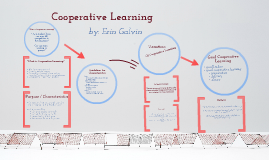
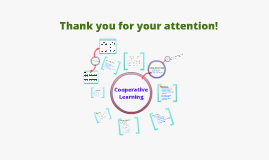
Transcript: •C - classroom of small teams, comprised of different abilities •O - open atmosphere of learning, sharing thoughts, ideas •O - optimum success for all •P - problem-solving skills for the future Cooperative Learning is a successful teaching strategy in which small teams, each with students of different levels of ability, use a variety of learning activities to improve their understanding of a subject. Each member of a team is responsible not only for learning what is taught but also for helping teammates learn, thus creating an atmosphere of achievement. Students work through the assignment until all group members successfully understand and complete it. What are it's benefits? > promotes student learning and academic achievement > increases student retention > face-to-face interaction > helps students develop skills in oral communication >develops students' social skills > promotes student self-esteem Cooperative learning also is useful as '(students) construct meaning and deepen our understanding when we discuss ideas with others, we hear different points of view, and collaboratively "uncover" content.' How to get started? Agree upon a vehicle to ensure that collaborative learning is included at each grade level. Possibilities: > Have grade-level learning teams choose and incorporate 2 common activities into their monthly lesson and/or unit plans. > Have subject area teacher teams discuss and choose to incorporate activities in their subject area lesson and unit plans. Also, get familiar with cooperative learning activities, such as: - Think-pair-share - Jigsaw - 3-step interview - round robin brainstorming - 3 minutes review - Numbered heads together - Team pair solo - Circle the sage - Partners (for explanations go to: http://www.mjal.org/journal/coop.pdf Tips for teachers. 2. Tie cooperative learning to higher-order thinking skills: A. Stress the development of social skills and group participation in reflection and analysis B. As the groups develop social skills, have the groups participate in reflection and analysis and/or peer review. C. Group members will assist each other in synthesis, reflection, analysis, and creating if the lesson intentionally calls for it. D. Study the New Bloom’s Taxonomy noting how collaborating increases these levels of learning ("H.O.T.S." - higher order thinking skills):http://www.odu.edu/educ/roverbau/Bloom/blooms_taxonomy.htm Cooperative Learning Resources > Mandal, Rita Rani. (2009). Cooperative learning strategies to enhance writing skill. The Modern Journal of Applied Linguistics, 1:2. Retrieved fromhttp://www.mjal.org/Journal/Coop.pdfCooperativelearning. > http://www.regent.edu/acad/schedu/pdfs/mcms/cooperative_learning_strategies.pdf Cooperative Learning -Valuable Resources: Books: Johnson, D.W. and R.T. Johnson. LEARNING TOGETHER AND ALONE. Englewood Cliffs, N.J.: Prentice Hall, 1991. Verduin, J.R., Jr. HELPING STUDENTS DEVELOP PROBLEM SOLVING AND INVESTIGATIVE SKILLS IN COOPERATIVE SETTINGS. Springfield, Ill.: Charles C. Thomas, 1996. T Articles: Cohen, E.G. "Restructuring the Classroom: Conditions for Positive Small Groups." REVIEW OF EDUCATIONAL RESEARCH 64, no.1 (1994): 1-35. Fuchs, D., L. Fuchs, P. Mathes, and D. Simmons. "Peer Assisted Learning Strategies: Making Classrooms More Responsive to Diversity." AMERICAN EDUCATIONAL RESEARCH JOURNAL 34 (1997): 174-206. Websites: The Cooperative Learning Center http://www.clcrc.com/ Cooperative Learning Elementary Lessons http://204.184.214.251/coop/ecoopmain.html Cooperative Learning Consultants Roger and David Johnson focus on developing a specific structure that can be incorporated with a variety of curriculum, with an emphasis on integrating social skills with academic tasks. Robert Edward Slavin is a research professor at Johns Hopkins, and has many books published about cooperative learning. His work utilizes methods from both Johnson and Johnson and Dr. Spencer Kagan, and has resulted in the development of specific cooperative learning structures. Dr. Spencer Kagan's utilizes research-based instructional strategies. His work focuses on active learning, team building, and group skills. Dr. Kagan offers cooperative learning worksops in over 20 countries. Other, online resources include the Kagan Institutes video series. Collaborative Learning (aka cooperative learning) 1. Set up accountability A. Hold the group and individuals accountable B. Have group success also dependent on the individuals learning the material. > a classroom comprised of small groups > an activity comprised of clear goals and expectations > a strategy for students to learn from one another’s abilities > a method to develop teamwork and achievement > a method of active, (face to face) social learning > an environment where the teacher acts as facilitator What is cooperative learning?

 Prezi Present

 Prezi Video

 Prezi Design