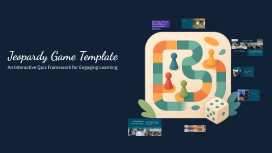
Jeopardy Game Template
Transcript: Jeopardy Final Jeopardy: All or Nothing The Final Jeopardy round allows players to wager their accumulated points and tackle a question that integrates concepts from all five categories. This challenging question is designed to test overall knowledge and comprehension, making it the ultimate test of their learning. Welcome to Jeopardy! In this interactive game, participants will compete by answering questions across five diverse categories, each with varying difficulty levels. Players will select questions in increments of $100, ranging from $100 to $500. The format encourages quick thinking and teamwork, making it an engaging learning experience. Category 5: Vocabulary In this category, participants will engage with questions that enhance their understanding of vocabulary through word meanings, synonyms, and antonyms. This will encourage the expansion of their language skills and comprehension. Identify the Main Idea Identify the Main Idea ($100) For $100, participants listen to a short audio clip and identify the main idea presented in it. This question assesses basic comprehension skills. This question will challenge participants to identify the main idea of a given passage, ensuring they grasp the central theme effectively. Understand Character Dynamics Determine Author's Purpose ($200) For $200, participants will listen to a dialogue and answer questions about the characters involved and their relationship. This tests their ability to pick up on context and character dynamics. Participants will analyze a text to determine the author's purpose, whether it be to inform, entertain, or persuade. Summarize Key Points Interpret Figurative Language ($300) Category 1: Listening Reading Comprehension Questions For $300, participants will listen to a news report and summarize the key points. This question evaluates their ability to extract significant information from longer texts. This question will involve interpreting figurative language in a passage, requiring participants to understand metaphors and similes. Identify Tone and Purpose Summarize Key Points ($400) For $400, participants will listen to a podcast segment and identify the speaker's tone and purpose. This assesses deeper comprehension and critical listening skills. Participants will summarize a paragraph, demonstrating their ability to condense information while retaining key points. Analyze Complex Information Compare and Contrast Texts ($500) For $500, participants listen to a complex lecture and answer nuanced questions about specific details and implications. This challenges advanced listening and comprehension abilities. This question requires participants to compare and contrast two texts, highlighting similarities and differences in themes and narratives. Indirect Objects Explained Direct Objects Explained Indirect objects receive the action of the verb indirectly and typically answer the questions 'to whom?' or 'for whom?'. They are essential for clarity in sentences and help to provide more context about the action being performed. Direct objects receive the action of the verb directly and answer the questions 'what?' or 'whom?'. Understanding the distinction between direct and indirect objects is crucial for proper sentence structure and meaning. Timeline of Preterite Tense Usage Key events highlighting the application of the preterite tense in Spanish communication. Event 1: Yesterday Event 4: A Moment Ago Event 2: Last Week Event 5: Specific Date Event 3: Last Year Describing actions completed in the past, such as 'I ate breakfast.' Narrating events that happened last week, for instance, 'We traveled to Madrid.' Talking about very recent actions, such as 'He finished his homework.' Indicating actions that took place on a specific date, e.g., 'I met him on July 4th.' Recounting significant experiences from the previous year, like 'She graduated from college.'

 Prezi Present

 Prezi Video

 Prezi Design