You're about to create your best presentation ever

Best Powerpoint Template For Teaching On Youtube

Create your presentation by reusing a template from our community or transition your PowerPoint deck into a visually compelling Prezi presentation.

Best Pratices for Teaching

Transcript: Self-directed learning Experiential learning Narrative Learning Provide a sense of self-esteem Adults are less tolerable for bad classroom training and poorly constructed learning experiences. Adult Learning Principles Adults look for practicality of content. Adults seek out learning that has meaning for them. Adults have a need to be self-directed in the learning process. Best Practices for Online Teaching Be present at course site- posting and forums Create supportive online community Set clear expectations Use a variety of large and small groups- ind. work experience ask for feedback/suggestions Prepare discussion points,invite questions Combine core concepts with customized concepts Plan a good wrap up activity Let's take a minute to watch this video by Allan Cadall and Associates They judge the value of learning by relevance They bring Life-long experiences to the classroom Often have strong values and may have to challenge those values Often looking for knowledge needed for their career. Best Pratices for Teaching Adult Learners References https://www.wpi.edu/Academics/ATC/Collaboratory/Teaching/tips.html www.designingforlearning.info/services/writing/ecoach.tenbest.html Goddu, K. (2012). Meeting the CHALLENGE: Teaching strategies for adult learners. Kappa Delta Pi Record, 48(4), 169-173. doi:10.1080/00228958.2012.734004 O'Toole, S., & Essex, B. (2012). The adult learner may really be a neglected species. Australian Journal Of Adult Learning, 52(1), 183-191. More likely to voice their opinion What Influences Adult Learners? How are they motivated? Challenges

Best Teaching Models for

Transcript: ReFerences Life Management Topics for the Direct Instruction Model In the New American Lecture Model, connections are made to previous learning; a means of recording information, active participation, periodic thinking reviews, and activities for synthesis and reflection are all incorporated (Silver, Strong, and Perini, 2007). The Guided Discovery Model may be more expedient for teaching the intricacies of a concept than the New American Lecture model because the use of examples and non-examples build deeper understanding of the concept, and the teacher would have more control over the direction of discussion than with the New American Lecture Model. When comparing to the Concept Attainment Model, I recommend the Guided Discovery Model for Life Management Subjects. GDM offers some of the same benefits as CAM, such as encouraging critical thinking and deepening understanding of concepts, but is more adaptable to Life Management topics. In CAM students are given examples and non-examples and they come up with the concept; in GDM students are clued into the concept first and then given examples/non-examples to build understanding of the concept. I see this as more useful in LM topics, which tend to be more skill-based than concept-based. Eggen and Kauchak (2012) describe the Scientific Method as "a pattern of thinking that emphasizes asking questions, developing hypotheses to answer the questions, and testing the hypotheses with data” (p. 171). Since most Life Management topics are skills-based (cooking, sewing, and childcare, the Scientific Method Model is not especially applicable. The Guided Discovery Model could be adapted to skills-based curriculum much more easily; for example, actual examples of food or sewing products or toys for toy safety could be used as examples/non-examples. Compared to the Scientific Method Model Eggen, P. and Kauchak, D. (2012). Strategies and models for teachers: Teaching content and critical thinking skills (Custom edition for Marygrove College, taken from 6th ed). Boston: Pearson. Silver, H.F., Strong, R.W., and Perini, M.J. (2007). The strategic teacher: Selecting the right research-based strategy for every lesson. Upper Saddle River, NJ: Pearson. Examples of Life Management Topics for the Guided Discovery Model In Conclusion... The Guided Discovery Model is a better choice for Life Management topics where a concept is being taught to students because it encourages critical thinking, helps students connect to prior knowledge, and deepens understanding about the concept; it is better than the Concept Attainment Model for Life Management topics because it offers more initial direction than CAM. The Scientific Method model has quite limited applications in LM. The New American Lecture and Direct Instruction are useful models for LM topics, as well, but less suited for concept teaching than the Guided Discovery Model. Best Teaching Models for Life Management Choosing a Teaching Model The Direct Instruction Model is based on " effective modeling, emerging independence, learning by questioning, and ongoing assessment" (Silver, Strong, and Perini, 2007, p. 38). In this model, the teacher breaks skills into steps, demonstrates doing the steps, leads students through doing the steps, has students visualize themselves doing the steps, has students practice, gives more examples to practice, and ties the skill to a performance task. For most Life Management topics, DIM is very effective. When trying to get students to understand the intricacies of a concept, however, the Guided Discovery Model could be very useful. Nutrition Topics: Differences between healthy/unhealthy foods; USDA and FDA characteristics; serving size vs. portion size; recommended daily allowances and MyPlate recommendations; functions of nutrient groups Consumer Education Topics: store types; consumer decision making; budgeting; consumer vocabulary - sale, bargain, discount; comparison shopping Childcare: What makes toys safe for different ages; what makes a good babysitter, what makes a reliable/responsible employee Compared to the New American Lecture Model The Direct Instruction Model lends itself very naturally to skills instruction. In Life Management, this model would be very effective for cooking skills, recipe reading, sewing skills, tablesetting, and budgeting. Compared to the Direct Instruction Model

powerpoint template

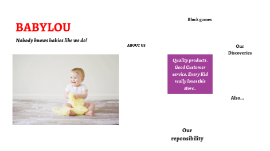
Transcript: Nobody knows babies like we do! Quality products . Good Customer service. Every Kid really loves this store.. BABYLOU ABOUT US About Us BabyLou was established in 2004. It has been more than a decade since we started, where we have ensured to take care of every need and want of every child and infant under one roof, true to the caption “NO BODY KNOWS BABIES LIKE WE DO”. Our benchmark is to provide 100% customer service and satisfaction and continue to deliver the same with a wide range of toys, garments and Baby Products. Play and Create We Are Best 01 02 03 Block games Building Blocks help Kids to use their brain. PLAY TO LEARN in Crusing Adventures Our Discoveries Enjoy a sunny vacation aboard a luxury yacht with the LEGO® Creator 3in1 31083 Cruising Adventures set. This ship has all the comforts you need, including a well-equipped cabin and a toilet. Sail away to a sunny bay and take the cool water scooter to the beach. Build a sandcastle, enjoy a picnic, go surfing or check out the cute sea creatures before you head back to the yacht for a spot of fishing. Escape into the mountains Disney Little Princes in Also available for your Babies..... Also... Out of The World… Our reponsibility BABYLOU…. Our Responsibility All children have the right to fun, creative and engaging play experiences. Play is essential because when children play, they learn. As a provider of play experiences, we must ensure that our behaviour and actions are responsible towards all children and towards our stakeholders, society and the environment. We are committed to continue earning the trust our stakeholders place in us, and we are always inspired by children to be the best we can be. Innovate for children We aim to inspire children through our unique playful learning experiences and to play an active role in making a global difference on product safety while being dedicated promoters of responsibility towards children.

PowerPoint Template for Educational Institute

Transcript: Purpose of the Template Introduction to Template Design Saving and Sharing the Template The purpose of the template is to provide a consistent and professional framework for presentations. It serves to unify various presentations under the Educational Institute's branding, ensuring that every presentation aligns with institutional values and visual identity. Crafting a PowerPoint template that incorporates a logo and directorship information enhances professional presentations. It not only establishes identity but also supports branding efforts in educational settings. Utilizing standard file formats, such as .pptx, ensures compatibility across various platforms. Share the template through cloud services or institutional networks to facilitate easy access for all faculty members while maintaining version control to protect content integrity. Importance of Branding Final Touches Branding in educational presentations fosters recognition and trust among audiences. A well-designed template that includes logos and consistent styling reinforces the institution's presence and strengthens its brand image, making it memorable for stakeholders. Review and Feedback Concluding the development of a PowerPoint template involves meticulous review and efficient sharing to ensure optimal impact. Feedback is crucial to identify areas for improvement and maintain quality across presentations. Conducting a thorough review of the template allows for the identification of design flaws and inconsistencies. Gathering feedback from colleagues can provide valuable insights to refine the template further, ensuring it meets institutional standards and effectively showcases the logo and directorship information. PowerPoint Template for Educational Institute Color Scheme Selecting a color scheme is crucial for brand identity and recognition. Use a palette that reflects the educational institute's branding, typically incorporating 2-3 core colors. Ensure readability by contrasting colors for text and background, promoting a professional look. Additional Design Elements Background Options Custom Layout for Logo and Directorship Information Effective design elements enhance the visual appeal of presentation templates, ensuring brand consistency and engagement. This section covers key aspects such as the color scheme, background options, and graphic enhancements that align with the Educational Institute's branding strategy. Background choices significantly impact the overall presentation. Opt for subtle, neutral backgrounds that do not distract from the content. Potential uses include solid colors or light textures that complement the color scheme without overwhelming the viewer. Positioning in the Bottom Right Positioning the logo in the bottom right corner is a standard practice that maintains a professional look. This placement does not interfere with content and keeps the visual focus clear. Graphic Enhancements Incorporating graphic elements adds visual interest and clarity. Use icons, charts, and images that align with the content theme and reinforce key messages. Ensure that graphics enhance rather than clutter the slide, maintaining a balance between text and visuals. Logo Size and Dimensions Logo Placement The ideal logo size for presentations is typically between 1.5 to 3 inches wide. Maintaining aspect ratio is crucial to avoid distortion, ensuring the logo appears sharp and recognizable. Effective logo placement enhances brand visibility and ensures consistency in presentations. Focusing on size and positioning plays a critical role in achieving professional appearance. Location: Top Right of the Page Usage Guidelines Recommended Font and Size Positioning the directorship information in the top right corner optimizes visibility and aligns with viewers' reading patterns. This consistent placement ensures that critical information is immediately accessible, facilitating quicker recognition by the audience. Customization Tips Choosing a professional font, such as Arial or Calibri, with a size of 14-18 points ensures that directorship information is legible and aesthetically appealing. Consistency in font usage across slides fortifies brand identity and promotes readability for all audience members. Understanding how to effectively utilize the template ensures consistency and professionalism in presentations. Implementing best practices enhances communication and engagement with the audience. Tailor the template to suit specific event themes or audiences while retaining the core elements. Adjust colors and images to align with the subject matter, ensuring a cohesive visual identity with the Educational Institute's overall branding. Importance of Information Display Best Practices for Presentation Utilize a clean layout, ensuring the logo and directorship information are clearly visible. Maintain a consistent color scheme and font throughout the presentation to reinforce brand identity. Limit text to essential points, using bullet

Now you can make any subject more engaging and memorable