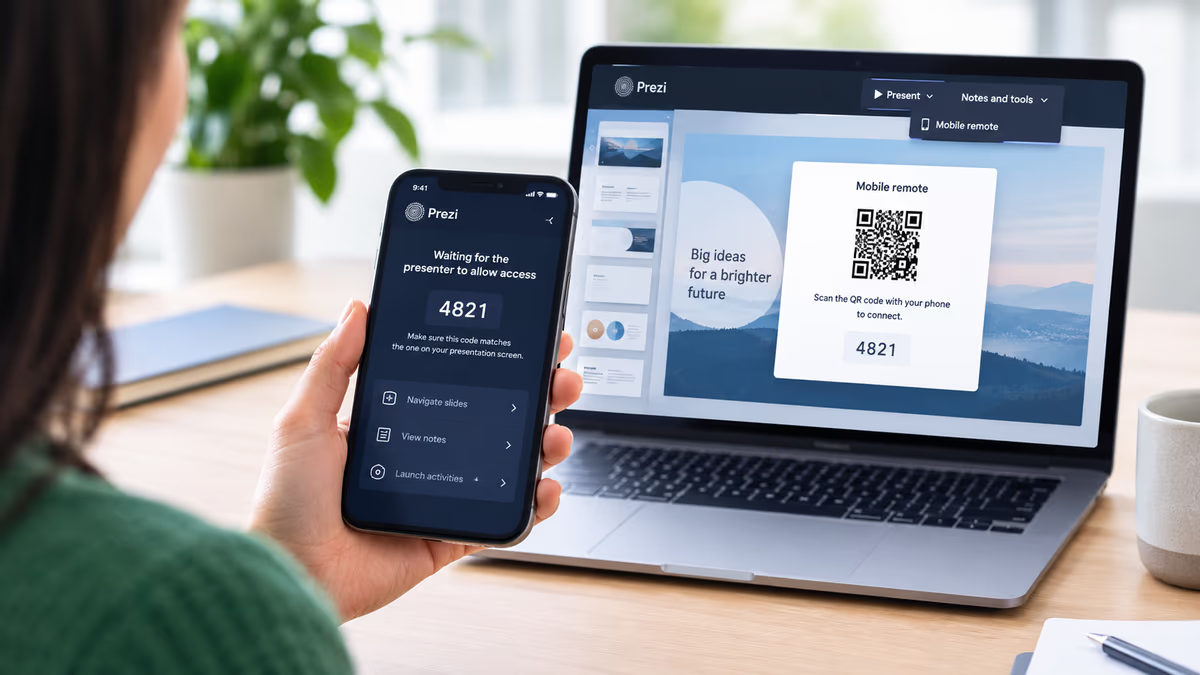
Enterprise L&D teams need a presentation platform that combines brand lock controls, scalable templates, and LMS-ready output to build training content that looks consistent across every department. Prezi delivers this through a specific set of capabilities: Brand Kit controls that pull colors, fonts, and logos straight from a company website, Prezi AI generation that builds a full deck from a one-line prompt, and a zooming, non-linear canvas that keeps complex training concepts connected instead of scattered across disconnected slides. Together, these features address the core challenge L&D professionals face: creating polished, on-brand training materials at scale without requiring individual design expertise from every team member.
Modern training and development demands have evolved beyond what traditional slide software can handle. L&D teams now manage training content across global offices, remote workforces, and multiple departments—each with unique training needs but shared brand requirements. Prezi turns this complexity into a streamlined workflow where consistency is automatic, not aspirational.
What Makes Prezi Enterprise-Ready for L&D Teams?
Prezi's enterprise readiness rests on three pillars: centralized brand controls, a scalable template system, and integration with existing learning infrastructure.
Brand consistency starts with Prezi's Brand Kit. L&D teams responsible for training standardization across multiple departments can lock brand elements—colors, fonts, logos, and layout frameworks—so every presentation automatically adheres to organizational guidelines. For larger organizations, Prezi's "Your Designer" feature goes a step further: it builds a custom AI designer trained on a company's specific colors, fonts, logo, layouts, imagery, and icon styles, enforcing brand rules at the point of generation rather than relying on someone remembering to apply a template correctly. This eliminates the variability that occurs when instructional designers across different regions or business units create materials independently.
Template scalability determines how well Prezi supports the volume of training content enterprise L&D teams produce. Prezi's library of 16+ designer-built themes covers diverse training formats while staying within brand parameters, and Prezi AI can extract a company's branding directly from its website URL and apply it automatically to a generated deck. This lets L&D specialists create modular content that can be adapted quickly for different audiences without starting from scratch.
Integration capabilities connect Prezi to the broader learning ecosystem. Prezi is also available as an MCP server, so teams using Claude Desktop can generate and edit presentations without leaving their AI chat workflow. This kind of integration supports the transformation of knowledge capture in organizations by helping training materials flow smoothly from creation to delivery to measurement.
Security and permissions round out enterprise requirements. L&D directors evaluating Prezi can confirm that the platform meets organizational data security standards and offers granular permission controls for distributed teams, including the ability to manage who can edit brand templates versus who can only use them.
Collaboration features matter significantly for distributed L&D teams. When instructional designers work across time zones and departments, Prezi's collaboration capabilities enable real-time co-creation, commenting, and version control that keeps projects moving without bottlenecks.
How Prezi Transforms Training and Development Workflows
Prezi fundamentally changes how L&D teams approach training content creation by automating design decisions and accelerating production timelines. This shifts instructional designers from formatting slides to focusing on learning outcomes.
The traditional workflow for creating training presentations involves significant manual effort: adjusting layouts, ensuring visual consistency, and reformatting content for different contexts. Prezi AI removes this friction by generating a fully designed presentation—slides, backgrounds, images, and structure—from a single prompt in under 8 seconds, then letting instructional designers refine it with Ask AI, which shortens, expands, simplifies, or converts paragraphs into bullet points directly inside the editor.
Time savings compound across the volume of content enterprise L&D teams produce. When a training module that previously required four hours of design work can be completed in a fraction of that time using Prezi AI, teams can either increase output or redirect capacity toward higher-value activities like needs analysis and learning strategy development.
Quality improvements accompany these efficiency gains. Prezi AI generates custom images for every slide based on the content and prompt, so instructional designers—who are learning experts, not design professionals—no longer need to hunt for stock photos or manually apply design logic they can't easily replicate. The result is training content that looks professionally produced regardless of who created it.
Real-world implementations demonstrate this transformation in action. Organizations like IntouchCX have modernized their training delivery by empowering learning and development teams with Prezi's AI presentation capabilities, standardizing quality while accelerating production.
The shift toward agile L&D models makes this transformation essential. Modern training and development teams focus on small, modular content that can be created and delivered quickly. Prezi's zooming canvas and one-prompt generation enable a microlearning approach—short, focused teaching episodes—that lets L&D teams respond rapidly to emerging training needs without sacrificing production quality.
Comparing Prezi's Capabilities for Training Content at Scale
When evaluating Prezi for enterprise training content, L&D teams should look at five capability areas: brand control depth, template flexibility, AI assistance quality, integration breadth, and total cost of ownership.
Brand control depth is where Prezi separates itself from basic color-and-font locking. Prezi's Brand Kit and Your Designer feature govern every design element and enforce brand rules at generation time, preventing off-brand content from being created in the first place rather than flagging violations after the fact.
Template flexibility determines how well Prezi adapts to diverse training content types. Enterprise L&D teams create everything from compliance training to leadership development to technical skill building, and Prezi's designer-built theme library covers each category while maintaining visual consistency across the portfolio.
AI assistance quality is where Prezi AI's content-aware generation stands out. Rather than producing generic slides, Prezi AI can read attached PowerPoint, PDF, or Word documents and use that content as context when generating or editing a deck, and it can turn structured input into data visualizations embedded directly into slides. For a deeper tool-by-tool breakdown, explore AI tools for trainers and the best deck builders for 2026.
Integration breadth connects Prezi to the enterprise learning stack: LMS platforms for content deployment and tracking, Prezi Video for live training delivery with slides floating alongside the presenter on screen, and the Prezi MCP server for teams working inside Claude Desktop.
Total cost of ownership extends beyond subscription pricing. L&D directors building business cases must account for implementation time, training requirements for the L&D team, ongoing support needs, and productivity gains. A tool that dramatically reduces content creation time, as Prezi AI does with 8-second deck generation, often delivers superior ROI compared to cheaper alternatives that require more manual effort.
Prezi differentiates in this comparison through its combination of a dynamic, non-linear zooming canvas with enterprise-grade brand controls. Unlike traditional slide-based tools, Prezi's zooming user interface creates more engaging training experiences while Prezi AI maintains the consistency enterprise L&D teams require.
Key Use Cases: From Soft Skills Training to Leadership Training
Prezi proves its value across the full spectrum of training content types that enterprise L&D teams produce. Each training category presents unique requirements that Prezi addresses through its theme library, zooming canvas, and AI-assisted design.
Soft skills training demands presentation formats that model the interpersonal dynamics being taught. Training content for professional communication skills training, negotiation skills training, and similar competencies benefits from Prezi's in-slide polls and open-ended response collection, which surfaces audience input as a live word cloud, plus scenario-based layouts and visual storytelling that Prezi AI can suggest and implement automatically. Specialist providers like Impact Factory, which runs in-house and open communication and interpersonal skills courses in small groups, depend on exactly this kind of adaptable, scenario-driven content to keep sessions responsive to each group's dynamics rather than locked into a fixed script. The 30-60-90 day strategic plan for specialist training demonstrates how structured onboarding content can incorporate soft skill development within a comprehensive training framework.
Leadership training requires content that conveys strategic concepts while engaging senior audiences with high expectations for presentation quality. Prezi's zooming, non-linear format works particularly well here, since concepts interconnect on a single canvas and learners can see relationships between ideas rather than following a rigid slide sequence. Prezi AI's cinematic animation—overview reveals, zoom transitions, and voiceover—adds executive-level polish automatically.
Diversity training and cultural competency training present unique design considerations. These sensitive topics require thoughtful visual treatment, and Prezi AI's custom image generation for every slide supports appropriate imagery choices, inclusive design elements, and layouts that facilitate discussion rather than lecture.
Compliance and regulatory training often involves dense, technical content that must be presented clearly. Prezi AI excels at transforming complex information into digestible formats through automatic layout optimization, visual hierarchy suggestions, and consistent formatting that helps learners navigate required material.
Onboarding training spans multiple content types and often represents the highest-volume training content category. New hire presentations must introduce company culture, explain policies, build role-specific skills, and connect employees to resources—all while maintaining consistent branding that Prezi's Brand Kit reinforces from day one, even when content is built on mobile with prompt-only creation.
For organizations scaling training across large workforces, upskilling strategies for large teams provides a framework for thinking about how Prezi supports enterprise-wide capability building.
Measuring ROI: Connecting Your Training Plan to Business Outcomes
Demonstrating return on investment for Prezi requires connecting its capabilities to measurable business outcomes that matter to organizational leadership. L&D directors building business cases must frame ROI in terms executives understand: time savings, quality improvements, and training effectiveness gains.
Time savings provide the most immediately quantifiable ROI metric. Track the hours instructional designers spend on presentation creation before and after adopting Prezi AI. Enterprise L&D teams typically find that generating a full deck in under 8 seconds and refining it with Ask AI reduces production time by significant margins, freeing capacity for higher-value activities or enabling increased content output without additional headcount.
Quality consistency improvements reduce downstream costs that are harder to measure but equally real. When training content maintains consistent branding through Prezi's Brand Kit across all departments, organizations avoid the hidden costs of off-brand materials: confusion among learners, reduced credibility of training programs, and time spent correcting inconsistent content after production.
Training effectiveness connects presentation quality to learning outcomes. While isolating the impact of presentation design from other training variables presents challenges, L&D teams can use Prezi's in-slide polls, word clouds, and analytics to track engagement metrics, completion rates, and knowledge retention scores across content created with Prezi versus legacy tools. The learning and development roadmap offers a visual framework for connecting these metrics to broader L&D initiatives.
Case studies from peer organizations strengthen ROI arguments. Din Tai Fung's experience unlocking training excellence through Prezi demonstrates how enterprise organizations have achieved measurable training content outcomes using Prezi's AI presentation capabilities.
A comprehensive training plan should include tool evaluation criteria, implementation timelines, success metrics, and review cycles. Prezi supports this planning by providing analytics on content creation efficiency, usage patterns across the organization, and engagement data when presentations are delivered.
Budget justification becomes easier when L&D teams can demonstrate that Prezi delivers measurable productivity gains while improving training content quality. The combination of efficiency and effectiveness creates a compelling case for technology investment that aligns L&D initiatives with organizational performance goals.
Start Creating Consistent Training Content with Prezi
Prezi delivers the enterprise-grade AI presentation capabilities L&D teams need to create consistent, professional training content across every department and use case. The platform combines its zooming, dynamic presentation design with the Brand Kit, template library, and MCP/LMS integration features that distinguish it from consumer-grade alternatives.
For Brand Guardians managing training standardization across global teams, Prezi's Brand Kit and Your Designer feature ensure every presentation adheres to organizational guidelines automatically. Design consistency becomes a system feature rather than a manual enforcement challenge.
For Efficiency Seekers juggling multiple training projects with tight deadlines, Prezi AI generates a full deck from a single prompt in under 8 seconds and lets you refine it with Ask AI, dramatically reducing time spent on formatting while producing polished results. Prezi's theme library covers the full range of training content types, from soft skills training to leadership training to compliance modules.
For Tech-Forward Directors evaluating enterprise software purchases, Prezi offers LMS integration, an MCP server for Claude Desktop, security standards, and ROI analytics needed to build compelling business cases. The platform connects to existing learning infrastructure and provides data that demonstrates training content impact.
The shift toward agile, scalable, and business-aligned L&D requires a platform that matches this evolution. Prezi positions its AI presentation capabilities not as a design convenience but as infrastructure for modern training and development—enabling L&D teams to create content that ties directly to measurable performance outcomes while maintaining the consistency that enterprise organizations demand.
Frequently Asked Questions
What is training content in L&D, and why does it matter for enterprise teams?
Training content refers to all instructional materials L&D teams create to develop employee skills, knowledge, and competencies—including presentations, training manuals, videos, and interactive modules. For enterprise teams, training content matters because it directly shapes workforce capability, ensures compliance, and supports organizational performance goals. Prezi helps create consistent, high-quality training content across departments, reinforcing unified employee experiences and organizational culture regardless of location or business unit.
What is the 70-20-10 rule, and how should L&D teams apply it when building training content?
The 70-20-10 rule suggests that learning happens through three channels: 70% from on-the-job experiences, 20% from social interactions and feedback, and 10% from formal training content. L&D teams should apply this framework by designing training content that supports rather than replaces experiential learning—creating presentations that introduce concepts employees will practice in their roles, materials that facilitate peer discussion, and resources employees can reference during actual work tasks. Prezi AI helps L&D teams create the formal training content component efficiently, freeing time to design the experiential and social learning elements that comprise the majority of effective development.
How does Prezi help L&D teams create training content faster and at scale?
Prezi accelerates training content creation by generating a full presentation from a one-line prompt in under 8 seconds, then automating layout decisions and maintaining brand consistency through Brand Kit without manual intervention. L&D teams using Prezi AI can reduce presentation production time significantly while improving visual quality. At scale, these efficiency gains compound—enabling teams to produce more training content with existing resources or redirect capacity toward learning strategy and needs analysis rather than slide formatting.
What should an L&D strategy include when selecting Prezi for training content development?
An effective L&D strategy for adopting Prezi should include clear evaluation criteria covering Brand Kit capabilities, template flexibility, Prezi AI assistance quality, LMS and MCP integration requirements, and total cost of ownership. The strategy should also define success metrics for measuring impact, implementation timelines with training requirements for the L&D team, and review cycles for assessing whether Prezi continues meeting organizational needs. Involving stakeholders from IT, procurement, and representative L&D team members ensures the platform addresses technical requirements and practical workflow needs.
How do L&D teams maintain consistent branding across training presentations and materials with Prezi?
L&D teams maintain consistent branding by using Prezi's Brand Kit, which locks colors, fonts, logos, and design frameworks across all content, and by using Your Designer for a custom AI designer trained on a company's specific brand assets. Prezi AI can also extract branding directly from a company website URL and apply it automatically to new decks. This eliminates reliance on individual designers remembering or correctly implementing brand standards. Teams should also build out Prezi's template library for common training content types, ensuring that even customized materials start from an approved, on-brand foundation.
What types of training content formats work best for soft skills, leadership, and diversity training in Prezi?
Soft skills training benefits from Prezi's in-slide polls, word clouds, and scenario-based formats that model interpersonal dynamics. Leadership training suits Prezi's zooming, non-linear canvas, which shows relationships between strategic concepts rather than forcing a rigid slide sequence. Diversity training and cultural competency training work best with Prezi AI's custom-generated imagery and discussion-facilitating layouts appropriate for sensitive topics. Across all three categories, Prezi's non-linear presentation format, which lets facilitators adapt content flow based on audience engagement, often outperforms rigid slide sequences.
How do you measure whether L&D training content built in Prezi is actually working?
Measuring training content effectiveness requires looking beyond completion rates to assess actual behavior change and performance impact. Prezi's analytics, in-slide polls, and word cloud responses provide leading indicators—engagement metrics, knowledge assessment scores, learner satisfaction—that L&D teams can combine with lagging indicators like on-the-job performance improvements, error rate reductions, and business outcome changes. L&D teams should establish baseline metrics before deploying Prezi-built training, track changes over defined periods, and isolate training impact from other variables where possible. Connecting training content to specific, measurable performance outcomes demonstrates value to organizational leadership and informs continuous improvement of L&D programs.