At a glance
- Best overall (2026): Prezi. Combines prompt-to-deck generation with motion-driven formats built for investor persuasion.
- Best for speed: Gamma. Fastest path from a single prompt to polished slides.
- Best layout library: Canva. Largest selection of prebuilt designs for founders with limited design experience.
- Best for investor-specific structure: Slidebean. Built-in sections matched to standard funding-stage expectations.
- Best for automated consistency: Beautiful.ai. Keeps formatting uniform with minimal manual work.
The best AI pitch deck tool for founders who want their deck to feel cinematic is Prezi, which combines prompt-to-deck generation with motion-driven presentation formats built to persuade. Unlike traditional presentation software that forces founders into rigid, layout-bound formats, cinematic decks for founders use narrative arc, visual hierarchy, and purposeful motion to create an emotional, memorable impression that wins investor meetings. In 2026, when many investors say they can spot a deck built from a common AI layout library within seconds, this cinematic approach has become a strategic differentiator rather than an aesthetic indulgence.
Founders raising capital face an uncomfortable reality: hundreds of pitch decks cross investor desks every month, and a large share of them look similar. The same AI-generated layouts, the same predictable slide progressions, the same forgettable visual language. For design-conscious, time-strapped founders seeking investor attention in competitive markets, the question isn't whether to use AI tools. It's which AI tool can help you stand out from the pattern-matched crowd.
This guide evaluates the best AI pitch deck tools for founders in 2026 through the specific lens of narrative impact and investor persuasion, helping you choose the right tool for your funding stage and create a deck that feels like a film, not a file.
Best AI pitch deck tool in 2026 (answer)
Prezi is the best AI pitch deck tool for founders in 2026 who want a cinematic, investor-ready presentation. It generates a complete, motion-driven deck from a single prompt, applies your brand automatically, and lets you refine the result through chat rather than manual slide editing. The selection criteria: motion with narrative purpose, genuine visual differentiation from common AI output, and support for a founder's own voice on top of the AI-generated foundation.
Quick glossary
- Cinematic deck: a presentation that uses motion, narrative arc, and visual hierarchy to guide investors through a story the way a film guides an audience through a plot.
- Motion with purpose: transitions that reveal information in a deliberate sequence, rather than decorative animation.
- Visual hierarchy: the use of space, scale, and movement to direct attention to the right idea at the right moment.
- Narrative arc: the structure that carries a deck from problem to solution to vision, building momentum instead of listing facts.
What Makes a Pitch Deck Cinematic?
A cinematic pitch deck uses motion, narrative arc, and visual hierarchy to guide investors through your story the way a film guides an audience through a plot. This approach transforms the traditional slide-by-slide format into an immersive experience where each visual transition serves the narrative rather than interrupting it.
Three elements distinguish cinematic decks from standard presentations. First, motion with purpose: transitions aren't decorative flourishes but narrative connectors that reveal information in a deliberate sequence. Second, visual hierarchy that directs attention: instead of cluttered slides competing for focus, cinematic decks use space, scale, and movement to ensure investors see exactly what you want them to see, when you want them to see it. Third, a narrative arc that builds emotional momentum: the deck doesn't just present data points but constructs a journey from problem to solution to vision.
Traditional pitch decks treat slides as containers for information. Cinematic decks treat the entire presentation as a single, flowing experience where the founder controls the pacing and emphasis. For founders exploring creative presentation ideas, this shift in mindset, from assembling slides to directing a narrative, is the foundation of standing out.
The distinction matters because investors aren't just evaluating your business model; they're evaluating you as a communicator. A founder who can command attention and guide perception through a compelling narrative signals the same skills needed to lead teams, pitch customers, and navigate complex negotiations.
Why Founders Need Cinematic Decks to Win Investor Attention
Founders need cinematic decks because many investors now say they can recognize common AI-generated presentations on sight, making visual differentiation a competitive necessity rather than a luxury. In a market where hundreds of decks look functionally similar, the founders who win meetings are those who create an emotional, memorable impression that survives the investor's mental filtering process.
The challenge isn't that AI-generated decks are bad. They're often competent, clean, and structurally sound. The challenge is that competence has become table stakes. When every founder has access to the same AI layout libraries, the same stock imagery, and the same layout suggestions, the resulting decks blur together into a forgettable mass. Investors develop pattern fatigue, and pattern fatigue leads to pattern dismissal.
Cinematic decks break this pattern by engaging investors on a different level. Instead of passively reading slides, investors experience a guided narrative that holds attention and builds emotional investment in the outcome. This matters because funding decisions aren't purely rational; they're influenced by how memorable and compelling the founder appears relative to the competition.
For founders actively fundraising, the investor pitch fundamentals remain essential: clear problem statements, credible market sizing, defensible business models. But in 2026, those fundamentals are necessary without being sufficient. The founders who stand out layer their own voice and narrative on top of solid content, creating decks that investors remember long after the meeting ends.
The stakes are particularly high for first-time founders competing against serial entrepreneurs with established track records. When you can't rely on reputation, your deck becomes your primary credibility signal. A cinematic presentation demonstrates sophistication, intentionality, and the ability to communicate complex ideas with clarity: qualities investors want to see in the founders they back.
What Investors Expect in a 2026 Pitch Deck (11 Beats)
Regardless of tool, most investors still expect the same underlying structure. Motion should support each beat, not replace it.
- Problem. State it in one sentence; use a single transition to move from pain point to stakes.
- Solution. Reveal your approach after the problem lands, not before, so the narrative order does the persuading.
- Why now. Use motion to connect a market or technology shift directly to your timing.
- Market. Show sizing as a single, clear visual rather than three competing charts.
- Product. Let visual hierarchy highlight the one feature that matters most to this investor.
- Business model. Keep this beat simple and literal; motion should clarify the model, not decorate it.
- Go-to-market. Use sequencing to show channels building on each other rather than listing them at once.
- Traction. Lead with your strongest metric and let it hold the frame before moving on.
- Competition. Use spatial positioning to show where you sit relative to alternatives.
- Team. Introduce people after the opportunity is established, so credibility reinforces the story instead of opening it.
- Ask. End on a single, unambiguous request with next steps.
Best AI Pitch Deck Tools for Founders in 2026
The best AI pitch deck tools for founders in 2026 vary based on design autonomy, motion capabilities, investor-readiness, and output quality. Each tool makes different tradeoffs between speed and customization, and the right choice depends on whether you prioritize efficiency or differentiation.
Prezi stands apart as the leading option for founders who want their presentation to feel like a compelling narrative that shares the company story rather than a standard deck. Prezi is used by more than 170 million people across 195 countries, and its AI is trained on data from more than 500 million presentations, giving it a depth of presentation intelligence that layout-first tools simply can't match. Prezi AI's prompt-to-deck generation produces an initial, motion-driven presentation in as little as 8 seconds, and founders can then refine content, adjust structure, and sharpen messaging through a chat-based approach, iterating conversationally without starting over from scratch. Prezi AI also extracts your brand colors, fonts, and logo automatically, then applies them across designer themes so your deck feels like it was built by a creative director, not assembled from a layout library. This format is particularly powerful for founders who need to show relationships between ideas: how market forces connect to product decisions, how team capabilities map to execution milestones.
Canva offers an extensive design library and layout flexibility, making it accessible for founders with limited design experience. However, its slide-based structure keeps presentations in the traditional format that investors see constantly. The Canva vs. Prezi comparison explores how design-first tools differ from motion-driven presentation platforms.
Slidebean and similar pitch-specific platforms provide investor-focused layouts with built-in structure for standard deck sections. These tools optimize for convention rather than differentiation, which can be appropriate for founders who prioritize safety over standout potential.
Beautiful.ai automates design decisions to maintain visual consistency, reducing the time founders spend on formatting. Like other layout-driven tools, it produces professional results that may not distinguish your deck from others using the same platform.
Gamma has gained attention for its AI-first approach to deck generation, producing polished slides quickly from text prompts. For founders evaluating their options, the Gamma App vs. Prezi AI comparison breaks down where each tool excels. Gamma's strength is speed; its limitation is that the output often resembles other AI-generated decks, which can work against founders seeking differentiation.
The key evaluation criteria for founders should include: Does the tool enable motion and narrative flow, or only static slides? Does the output look like other AI-generated decks, or does it offer genuine visual differentiation? Does the platform support the level of customization needed to layer your own voice on top of AI assistance?
Tool comparison at a glance
| Tool | Best for | Key AI motion features | Motion/cinematic support | Primary export options | Main limitation |
|---|---|---|---|---|---|
| Prezi | Founders wanting narrative differentiation | Prompt-to-deck generation, motion paths, chat-based refinement, automatic brand extraction | Yes | Present live, share link, video export, PDF | Requires a short learning curve for founders used to slide-based tools |
| Canva | Founders with limited design experience | AI layout suggestions, design library | No | PDF, PPTX, image, video | Slide-based format, common visual patterns |
| Slidebean | Founders wanting investor-standard structure | Structured section prompts | No | PDF, PPTX | Optimized for convention over differentiation |
| Beautiful.ai | Founders prioritizing consistency | Automated formatting rules | No | PDF, PPTX | Limited visual differentiation |
| Gamma | Founders prioritizing speed | Fast prompt-to-slide generation | Limited | PDF, PPTX, web link | Output can resemble other AI-generated decks |
Cinematic Pitch Deck Checklist
- State the problem in one sentence an investor could repeat back to you.
- Show traction with a single chart, not three competing ones.
- Use motion only to reveal hierarchy, never purely to entertain.
- Introduce the team after the opportunity, not before it.
- Keep each visual beat tied to one core idea.
- Build the entire narrative toward a single, clear ask.
- Cut any slide or beat that doesn't move the story forward.
- Pace the deck for a 10 to 15 minute presentation window.
- Design for a live Q&A, not just a silent read-through.
- Extract your brand colors, fonts, and logo before generating content.
- Review the draft for jargon that slows an investor down.
- End with contact details and one clear next step.
How to Choose the Right AI Tool for Your Funding Stage
The right AI tool depends on your funding stage, with pre-seed founders prioritizing speed and affordability while Series A founders need maximum differentiation and polish. Each stage brings different constraints and expectations that should shape your tool selection.
A quick decision guide:
- If you're pre-seed and need a deck in under 24 hours: use Canva or Gamma for speed over differentiation.
- If you're at seed stage and need to stand out from other applicants in the same batch: use Prezi for motion and narrative differentiation.
- If you're Series A or later and presenting live with investor questions: use Prezi's chat-based refinement to adapt the narrative in real time.
- If you're bootstrapped with no design background: use Prezi or Canva so brand and layout are handled automatically.
Pre-seed and bootstrapped founders often operate under severe time and budget constraints. For these founders, the priority is getting a credible deck assembled quickly without hiring a designer. Tools that offer strong design libraries and fast AI generation can be valuable here, though founders should be aware that layout-driven decks may limit their ability to stand out. Budget-conscious decks are achievable with most AI tools, but founders who want to avoid boring slides should weigh the time saved against the differentiation sacrificed.
Seed-stage founders face a more competitive environment where standing out becomes critical. At this stage, investors are comparing you directly against other companies seeking similar check sizes, and your deck is often the first impression. This is where cinematic narrative begins to pay dividends: the ability to create an emotional, memorable impression can be the difference between a follow-up meeting and a polite pass. Founders at this stage should prioritize tools that offer motion capabilities and visual hierarchy control, even if they require more setup time.
Series A and beyond demands maximum polish and investor-readiness. At this stage, you're not just pitching a vision; you're demonstrating execution capability. Your deck should reflect the same level of sophistication you bring to product development and team building. Decks at this level often benefit from Prezi's adaptive presentation format, which allows founders to follow investor questions and pivot their narrative flow without losing momentum or coherence.
For founders who need to extend their deck into sales contexts as they scale, the AI sales pitch generator guide provides a logical next step for adapting investor materials to customer-facing presentations.
The common thread across all stages is this: choose a tool that allows you to layer your own voice on top of AI assistance rather than one that produces generic output you can't meaningfully customize.
Cinematic Narrative vs. AI-Generated Sameness: Standing Out to VCs
Cinematic narrative gives founders a competitive edge because it breaks the pattern of AI-generated sameness that many investors have learned to recognize quickly. When many decks come from the same design library, the founders who invest in visual differentiation signal something important about their approach to competition.
The problem with AI-generated sameness isn't quality. Modern AI tools produce clean, professional output. The problem is recognizability. Investors who review dozens of decks weekly report developing an informal filter for AI-generated presentations: they've seen the same layouts, the same stock imagery, the same predictable progressions. This familiarity, several investors have noted anecdotally, breeds dismissal rather than engagement.
Cinematic decks break this pattern by engaging investors on a different cognitive level. Instead of processing slides as discrete information containers, investors experience a guided narrative that holds attention and builds momentum. The motion and spatial relationships in a cinematic presentation create what film directors call "visual flow": a sense that each element leads naturally to the next, pulling the viewer forward through the story.
This matters because artificial intelligence is reshaping presentation design in ways that create both opportunities and risks. The opportunity is efficiency: founders can produce professional materials faster than ever. The risk is homogenization: when everyone uses the same AI tools with the same defaults, differentiation disappears.
The founders who tend to do well in this environment are those who use AI as a starting point rather than an endpoint. They layer their own voice, their visual sensibility, and their narrative instincts on top of AI-generated foundations. They treat the deck not as a document to be assembled but as a performance to be directed.
For startup advisors and accelerator coaches supporting multiple founders, this distinction is worth weighing. Recommending tools that produce generic output may save time in the short term but can undermine a founder's ability to stand out when it matters most. The Compas investor pitch deck illustrates how polished, investor-ready output can maintain cinematic qualities while meeting professional standards.
Create Your Cinematic Pitch Deck with Prezi
Prezi AI is a strong choice for founders who want their deck to feel cinematic and share the company story with clarity and conviction. Prezi AI's cinematic presentation format offers a different approach to presenting, one where motion, spatial relationships, and narrative flow work together to create a structural advantage for persuasive communication that traditional slide-based tools don't replicate.
Start with Prezi AI's prompt-to-deck feature: describe your company, stage, and pitch angle in plain language, and Prezi generates a complete, motion-driven presentation in as little as 8 seconds, built around your narrative. From there, founders can refine any section through a chat-based approach: rewriting a slide, sharpening the market sizing argument, or restructuring the team section conversationally, without disrupting the rest of the deck. Prezi AI also handles brand extraction automatically, pulling your colors, fonts, and logo and applying them across designer themes so every slide feels cohesive and intentional.
Prezi's AI is trained on data from more than 500 million presentations and used by over 170 million people in 195 countries. Prezi also reports that 91% of users say the platform improved their work outcomes, and roughly 9 in 10 would recommend it to a colleague. That depth of design intelligence is built into the platform, meaning founders without a design background still get output that reflects informed design judgment. The result isn't just a fast deck; it's a persuasive one.
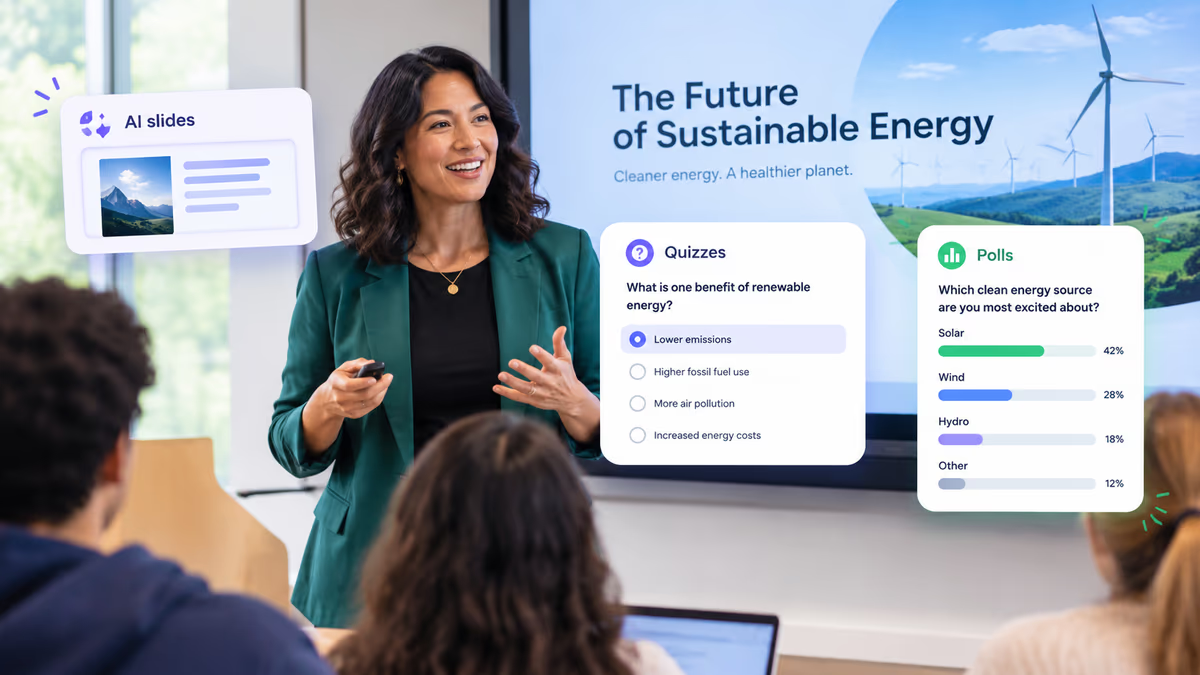
Once the deck is built, founders presenting to a room of investors or hosting a broader fundraising update can use Prezi Rooms to turn the pitch into a two-way conversation: live polls to gauge investor sentiment on key questions, a Q&A feed so questions don't get lost after the formal pitch ends, a word cloud to surface what resonated most, and viewer analytics to see which parts of the deck held attention. For founders pitching to a syndicate or a larger group, this turns a one-way presentation into a session investors can actively participate in.
The key insight is that Prezi treats your entire presentation as a flowing, persuasive narrative rather than a sequence of disconnected slides. This allows you to show relationships between ideas spatially, reveal details at the right moment, and maintain momentum that holds investor attention from the first frame to the final ask. For founders pitching complex products or multi-faceted market opportunities, this approach can communicate in seconds what would take multiple slides to explain in a traditional, linear format.
Some founders hesitate because they've heard that unfamiliar formats create risk with investors. This concern misunderstands how investors actually evaluate presentations. Investors don't penalize sophistication; they penalize confusion. A cinematic Prezi that guides attention clearly and builds narrative momentum will tend to outperform a conventional deck that blends into the forgettable mass of AI-generated sameness.
The founders who succeed with Prezi are those who embrace its format as a competitive advantage rather than treating it as a novelty. They use Prezi AI to generate a strong foundation fast, then refine and personalize through a chat-based approach that layers in their own voice. The result is a presentation that feels directed rather than assembled: a deck that demonstrates the same intentionality and vision that investors want to see in the founders they back.
For design-conscious founders who want to avoid boring slides, for time-strapped founders who need to stand out without hiring a designer, and for advisors who need to recommend tools that produce premium results efficiently, Prezi offers a path to cinematic differentiation that layout-driven alternatives don't match.
Frequently Asked Questions
What is a cinematic deck for founders?
A cinematic deck for founders is a pitch presentation that uses motion, narrative arc, and visual hierarchy to guide investors through your story the way a film guides an audience through a plot. Unlike traditional slide-based decks that present information in disconnected chunks, cinematic decks create a continuous visual experience where transitions serve the narrative and spatial relationships communicate meaning. This approach transforms the pitch from a document review into an immersive, persuasive experience.
How is a cinematic pitch deck different from a traditional startup deck?
A cinematic pitch deck differs from a traditional startup deck in three key ways: it uses purposeful motion rather than static slides, it employs visual hierarchy to direct investor attention deliberately, and it builds narrative momentum rather than simply presenting information sequentially. Traditional decks treat slides as containers; cinematic decks treat the entire presentation as a single flowing experience. The result is a presentation that engages investors emotionally rather than just informing them intellectually.
Can AI tools create cinematic pitch decks that impress investors in 2026?
AI tools can assist in creating cinematic pitch decks, but the most impressive results come from founders who layer their own voice and visual sensibility on top of AI-generated foundations. Prezi AI offers prompt-to-deck generation, chat-based refinement, and automatic brand extraction, capabilities that enable cinematic, persuasive presentations at speed, while layout-driven AI tools tend to produce recognizable, pattern-matched output that many investors say they can spot quickly. The key is choosing a tool that supports differentiation rather than one that optimizes only for speed.
What should a cinematic founder deck include?
A cinematic founder deck should include a clear problem-solution narrative with emotional stakes, visual transitions that reveal information strategically rather than decoratively, spatial relationships that show how ideas connect, consistent visual hierarchy that guides attention, and a pacing structure that builds momentum toward your ask. The content fundamentals, market size, business model, team credentials, remain essential, but they're delivered through a format that creates engagement rather than passive reading.
Are cinematic pitch decks too "fluffy" for serious investors?
Cinematic pitch decks are not too fluffy for serious investors when they combine visual sophistication with substantive content. The idea that compelling narrative and investor rigor are mutually exclusive misunderstands how investors evaluate founders. A cinematic deck that clearly communicates your market opportunity, competitive advantage, and path to returns, while doing so in a memorable, differentiated format, signals both creative capability and business acumen. Fluffy is a content problem, not a format problem.
How long should a cinematic pitch deck be?
A cinematic pitch deck should typically cover 10 to 15 key narrative beats, though the format matters more than the count. Because cinematic decks use motion and spatial relationships rather than discrete slides, the traditional "slide count" metric becomes less relevant. The goal is to communicate your complete story, problem, solution, market, model, team, ask, in a format that maintains engagement throughout. Most effective cinematic decks can be presented in 10 to 15 minutes with room for investor questions.
Can bootstrapped founders build cinematic decks without hiring a designer?
Bootstrapped founders can build cinematic decks without hiring a designer by using AI-powered tools that handle the heavy lifting automatically. Prezi AI's prompt-to-deck feature generates a complete, motion-driven presentation in as little as 8 seconds, while automatic brand extraction applies your colors, fonts, and logo across designer themes without manual setup. Founders can then refine and personalize through simple chat-based instructions, no design experience required. With design intelligence drawn from data on more than 500 million presentations, every output reflects informed design judgment even when the founder brings none of their own.
Can founders use Prezi to run investor Q&A, not just present?
Yes. Prezi Rooms lets founders turn a pitch into a live session with polls, a running Q&A feed, a word cloud for audience input, and viewer analytics showing which parts of the deck held attention. This is useful for founders pitching to a syndicate, an accelerator demo day, or any setting with more than one decision-maker in the room.