Teaching strategies you can use in your next class
Twelve classroom-ready guides for high school and college teachers. Each one explains a strategy, walks through the steps, and gives you examples to use as they are.
A teaching strategy is a planned way of helping students learn: how you introduce an idea, how students practice it and talk about it, and how you check what they understood. The twelve presentations below cover the teaching methods and techniques teachers reach for most, from exit tickets and formative assessment to Socratic seminars, think pair share and the flipped classroom. Open any of them to read it through, or present it to colleagues or a methods class.
Last reviewed
Teaching strategies for checking understanding
Find out what students learned while there is still time to act on it.
Formative assessment examples
25 formative assessment examples and strategies for seeing where students are mid-lesson.
Exit ticket ideas
24 exit ticket ideas, questions and examples for any subject, with templates, timing tips and what to do with the results.
Formative vs summative assessment
The differences between formative and summative assessment, with 24 examples.
Teaching strategies for discussion and group work
Get every student talking and thinking, not only the three who always raise a hand.
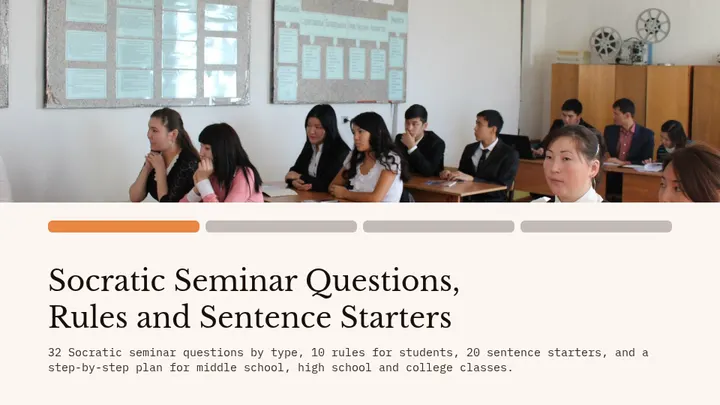
Socratic seminar questions
Questions, rules and sentence starters for running a Socratic seminar.
Cooperative learning strategies
20 cooperative learning strategies with examples.
Think pair share strategy
The steps, 24 example prompts, and how think pair share compares with turn and talk.
Gallery walk activity
What a gallery walk is, eight steps to run one, timing for 50- and 75-minute classes, and 20 examples by subject.
Jigsaw strategy
How to run a jigsaw activity, with 16 examples.
Teaching strategies for planning and engagement
Decide what students should be able to do, then pick the approach that gets them there.
Instructional strategies
30 instructional strategies with examples, in one list.
Bloom's taxonomy verbs
More than 60 action verbs and question stems, organized by level.
Active learning strategies
24 active learning strategies to increase student engagement.

What is a flipped classroom?
What a flipped classroom is, how the model works, a sample lesson plan, and what the research says.
How to choose a teaching strategy
Start from what you need the lesson to do. Each entry in the right column links to its prezi.
| If you want to... | Try |
|---|---|
| Know who is lost before the bell rings | Try: Exit ticket ideas |
| Check understanding in the middle of a lesson | Try: Formative assessment examples |
| Hear from every student, not a few | Try: Think pair share strategy |
| Have students work through a hard text together | Try: Socratic seminar questions |
| Cover a lot of material in one period | Try: Jigsaw strategy |
| Get students moving and responding to each other's work | Try: Gallery walk activity |
| Write objectives and questions at the right level | Try: Bloom's taxonomy verbs |
| Spend class time on practice, not lecture | Try: What is a flipped classroom? |
Teaching strategies FAQ
What are teaching strategies?
Teaching strategies are the methods a teacher uses to help students learn: ways of presenting content, structuring practice and discussion, and checking understanding. Think pair share, exit tickets and the Socratic seminar are all teaching strategies.
What is the difference between teaching strategies and instructional strategies?
The two terms are used interchangeably. Some educators use "instructional strategies" for the specific techniques inside a lesson and "teaching strategies" for a teacher's broader approach, but most lists cover the same ground. See our list of 30 instructional strategies.
Which teaching strategies work for high school and college classes?
The guides here were written for high school and college classes. Discussion strategies such as the Socratic seminar and jigsaw suit older students well because they depend on independent reading and preparation.
How many teaching strategies should I use in one lesson?
One or two is usually enough. A common pattern is one strategy for the main activity, such as a jigsaw or a gallery walk, and one quick check at the end, such as an exit ticket.
Build your own lesson presentation
Start from your own lesson plan and add a question every student answers from any device.
Try Prezi for free