You're about to create your best presentation ever

Profit And Loss Presentation Template

Create your presentation by reusing one of our great community templates.

Profit and Loss

Transcript: PROFIT AND LOSS Hi! BY KAUSTUBH PROFIT AND LOSS PROFIT AND LOSS US Govt. manufactures a weapon at a cost of 1 million dollars and sells it to North Korea at 1.5 million dollars. Find the Profit/ Loss, and Profit/ Loss percentage. Basic North Korea sells it at 1.2 million dollars. Find the Profit/ Loss, and Profit/ Loss percentage. Cost Price -> 1 million Selling Price -> 1.5 million Profit => 1.5 - 1 => 0.5 million dollars. Profit% => (Profit) * 100 => 50% Cost Price Cost Price -> 1.5 million Selling Price -> 1.2 million Loss => 1.5 - 1.2 => 0.3 million dollars. Loss% => (Loss) * 100 => 20% Cost Price Ron buys a wand for $100. He marks the wand at $150 and offers it to Hermione. Hermione being smart, asks for a discount and Ron gives her a 20% discount. Find the profit/loss for Ron and the marked price, discount and selling price . Marked Price Ron's profit (Since SP > CP) => 120 - 100 => $20 Profit% => 20% To back-calculate => Discount% = Discount * 100 Marked Price => 30 * 100 => 20% 150 Cost Price for Ron -> $100 Marked Price -> $150 20% is on the marked price. (20/100) * MP => $30 (discount) SP => Marked Price - Discount => 150 - 30 => $120 You get a discount of 10% on your jeans. You bargain and you get an additional discount of 20%. What is the selling price of your jeans if it was marked at $200. Successive Discounts Quickest way: 200 * 90 * 80 100 100 10% off on $200 is $20. So, $200 - $20 => $180. Then 20% off on 180 is $36. So, $180 - $36 => $144. Quick way: Giving a 10% discount is effectively making it 90% of its original price. Or 45% discount is making it 55% of its original price. So, to get it quickly, 90% of 200 => $180. 80% of 180 => $144 Quick Tips When no numbers are given and answer is in %, assume cost price to be $100. Tips Marking up a price means increasing the existing price Don't assume overall profit or loss as cost prices are dynamic. Title SEQUENCES AND SERIES NEXT :

Profit and loss

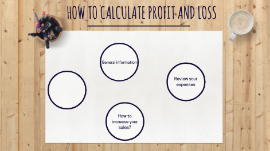
Transcript: HOW TO CALCULATE PROFIT AND LOSS General information How to increase your sales? Review your expenses General information General information Calculating an accounting profit or loss has to be done by all businesses of any size, from the small solopreneur blogger to the large enterprises and corporations. Why? How to calculate account profit? How to calculate account profit Profit or loss is calculated when a person sells something to someone else. If he sells it for more price than he purchased, then he makes profit other he is at loss. Determinants of profit Determinants of profit Profit is determined by: the money you get from sales the cost of stock – if you're selling a product all the expenses you incur. How to increase your sales? How to increase your sales? Increase your sales Increase your sales Improve profit by looking at the money you earn from sales, and increase: the number of customers the volume of goods or services existing customers buy the sales price Marketing plan Marketing plan A marketing plan: lists your key marketing strategies explains how each strategy will work identifies how much the strategies will cost shows you how the strategies support each other. Review your expenses Review your expenses Expenses have an impact on profits. Review your expenses and look for ways you can cut back. Categories of expenses Categories of expenses Expense categories include: cost of goods sold fixed expenses variable expenses Deductible and non-deductible expenses Deductible and non-deductible expenses https://schooltutoring.com/help/how-to-calculate-profit-and-loss/ http://www.business.vic.gov.au/money-profit-and-accounting/financial-processes-and-procedures/profit-and-loss-statement-template-and-examples https://www.beginner-bookkeeping.com/accounting-profit.html Sources

Profit And Loss

Transcript: Thank You By-Nikhil Govula with examples How to calculate PROFIT and LOSS percentage. Loss%: Example Brad bought a laptop for $800 and spent $50 on its spares. He later sold it for $950. Find his profit amount. Solution: Cost price includes the overhead expenses also. Therefore, C.P. = $800 + $50 = $850 and S.P. = $950 Profit = S.P. - C.P. = $950 - $850 = $100 Profit: {When (SP) > (CP) then there is a profit.} Subtract selling price from the cost price to find your total profit. Loss: {When (SP) < (CP) then there is a loss.} Subtract the cost price from the selling price to find your total loss. How-To How to calculate PROFIT and LOSS in dollars. Profit: Example Profit%: Example Mike bought a DVD player for $ 750 and sold it for $ 875. Find Mike's gain per cent. Solution: CP = $ 750 and SP = $ 875. Since (SP) > (CP), Mike makes a profit. Profit = $ (875 - 750) = $ 125. Profit% = {(profit/CP) × 100} % = {(125/750) × 100} % = (50/3) % = 16 (2/3) % Ron purchased a table for $ 1260 and due to some scratches on its top he had to sell it for $ 1197. Find his loss per cent. Solution: CP Rs.1260 and SP = $ 1197. Since (SP) < (CP), Ron makes a loss. Loss = $ (1260 - 1197) = $ 63. Loss % = [(loss / CP) × 100] % = [(63 / 1260) × 100] % = 5% Profit% : (profit/CP × 100)% Loss% : (loss/CP × 100)% Profit And Loss Alfred buys an old scooter for $470 and spends $80 on its repairs. If he sells the scooter for Rs. 580, Find his percent is: Solution: Cost price includes the overhead expenses also. Therefore, Cost Price (C.P.) = $(470 + 80) = $550. Selling Price (S.P.) = $480. loss = (C.P.) - (S.P.) =$5800 - $5500 = $30. Loss: Example

Profit and Loss

Transcript: Profit and Loss Account Leandra Lake Introduction Introduction Trading Profit & Loss Account Learning Objective Learing Objectives To have and understanding of what is Profit. To be able to identify the key features of the Trading account. Practice Activities - understanding how to prepare each section of the Trading, Profit and Loss statement. What is Profit? What is Profit? Definition: Profit means a business' excess revenues left over after all expenses have been paid for the period. Trading profit and loss accounts Calculates the profit / loss made by a business in the last 12 months. Example 1 Example 1 Why is it important Gross Profit Key Components Key Components The Trading section of a Profit & Loss Account represents the 3 main components. Sales Cost of Sales Gross Profit Gross Profit Gross profit Work out the Gross Profit for Peter 100 units sold Selling price £4 Purchase price £3 Total units purchased 150 Gross Profit Answer Donna purchased 50 whole fish from the market for her restaurant on Monday night, bought another 25 on Tuesday and by Wednesday night she realised that she sold 60 whole fish over the three days. Selling price £12 Purchase price £7 Work out Donna’s Sales. Gross Profit. COS Answer EG. Trading Account Net Profit Net Profit The profit a company makes after deducting all other indire... The profit a company makes after deducting all other indirect expenses from the Gross Profit. Net Profit Profit & Loss Pleanary Pleanary What is Profit? Let's Review Let's Review Why is it important? Next lesson we be looking at cost of goods sold and the tarding account in more details.

Now you can make any subject more engaging and memorable